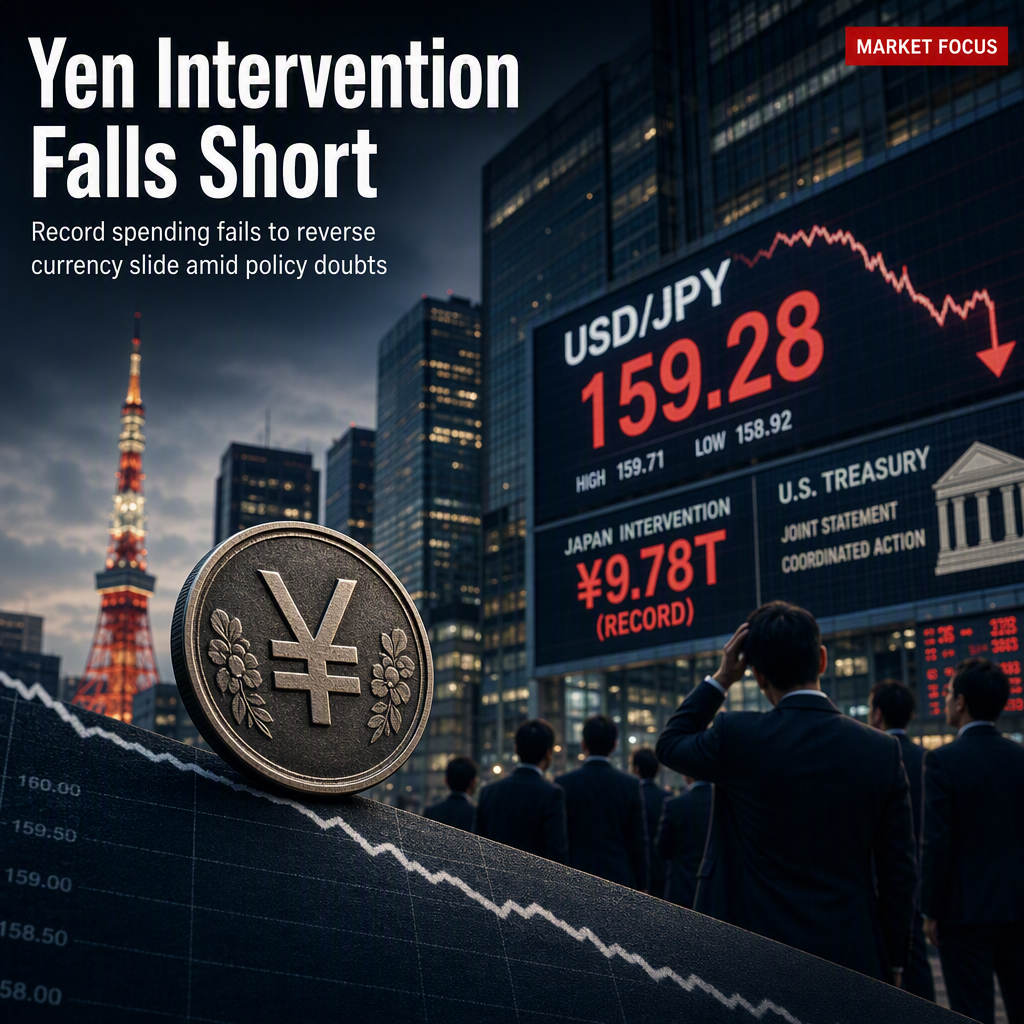
Japan, in coordination with the U.S., undertook a significant intervention in the foreign exchange market last week to support the yen, but the effort has had limited and short-lived impact on the currency's trajectory [1][2]. Analysts estimate that Japan may have spent as much as $32 billion in the latest round of intervention [1], while FXStreet reports that Tokyo spent a record 8.45 trillion yen in a single session, followed by an additional 5.3 trillion yen in coordination with the U.S. Treasury—the first joint yen-buying operation between the two countries since 1998 [2]. Despite these unprecedented sums, the yen's rally was brief, and it soon resumed weakening against the dollar, with the USD/JPY pair rising 0.93% in the session to trade just above 159.00, recovering about half of its drop from a recent multi-decade peak [2].
Market participants and analysts attribute the intervention's limited effectiveness to persistent doubts over Japan's fiscal and monetary policy. The Bank of Japan continues to maintain an ultra-loose monetary stance, with its policy rate at 1.00% compared to the U.S. range of 3.50% to 3.75% [1][2]. Technical analysis shows the yen remains vulnerable, with key support levels repeatedly breached and resistance near 150 yen to the dollar being closely watched [1]. Fund managers remain cautious, hesitating to increase exposure to the yen until there are clear signs of policy tightening from the Bank of Japan [1].
A major factor undermining the yen was a surprise swing in Japan's June current account, which posted a deficit of 92.3 billion yen against expectations for a surplus of nearly 1.5 trillion yen and a May reading just short of 4 trillion yen [2]. This marked the first monthly deficit in about a year and a half, driven by an inflated import bill due to higher energy prices and a weaker currency [2]. The data release, which occurred hours before the Tokyo session that began the latest leg higher in USD/JPY, was seen as a catalyst for the yen's renewed weakness [2].
Japanese authorities have signaled their willingness to intervene again and have highlighted access to the Federal Reserve's repo facility for foreign monetary authorities as a sign of their available resources [2]. However, both sources agree that without a fundamental shift in Japan's monetary and fiscal policy, interventions are likely to have only fleeting effects [1][2].
CONCLUSION
Despite record-breaking intervention efforts by Japan and the U.S., the yen remains under pressure due to persistent policy gaps and deteriorating fundamentals. Market participants remain skeptical of the effectiveness of intervention without decisive policy tightening from Japanese authorities. The outlook for the yen remains negative unless there is a clear shift in Japan's fiscal and monetary stance.