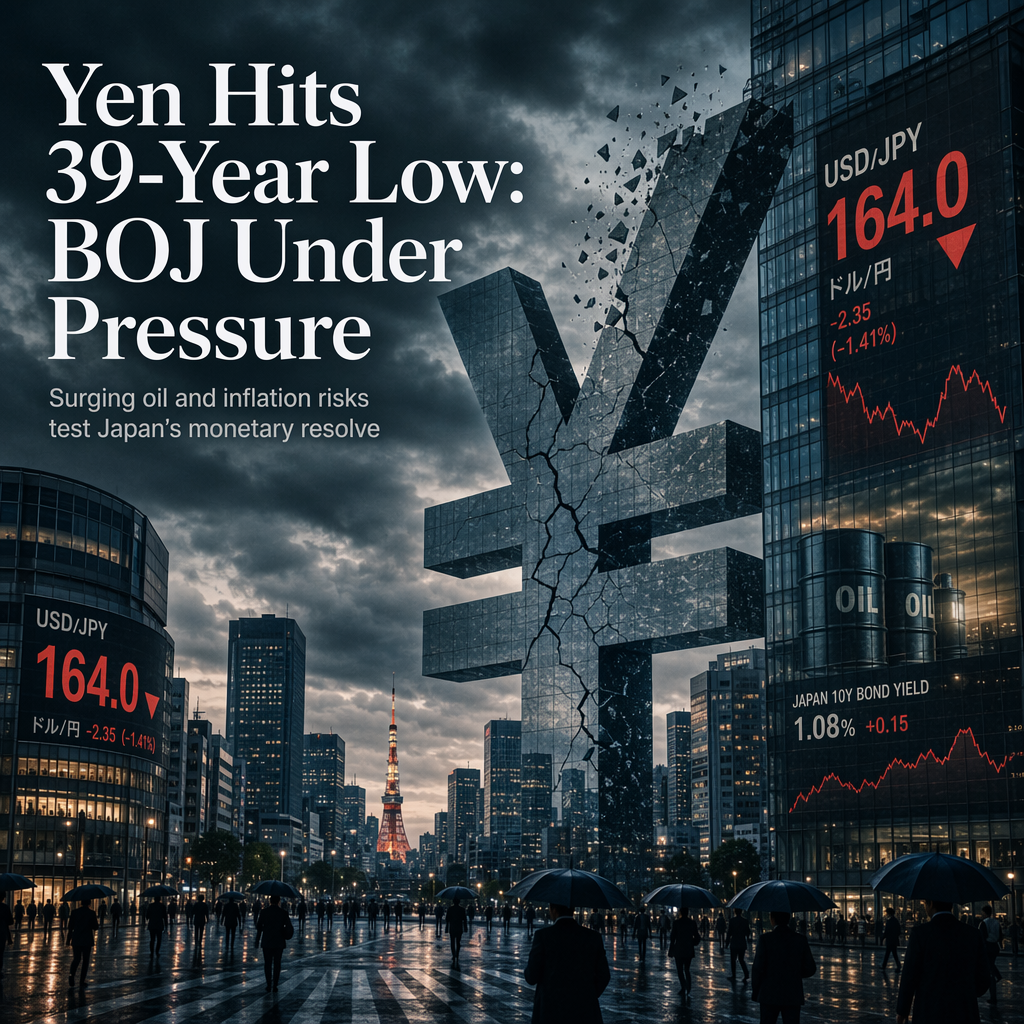
The Japanese yen is approaching 164 per dollar, its lowest level in 39 years, intensifying expectations that the Bank of Japan (BOJ) may raise interest rates sooner than previously anticipated to address mounting inflation risks and prevent further currency depreciation [1]. The yen's slide is being driven by renewed inflation concerns stemming from escalating Middle East tensions, particularly between the US and Iran, which have pushed oil prices above $100 per barrel [1]. Japanese bond yields are also rising toward 3% as fiscal fears escalate, adding urgency for the BOJ to consider policy action [1].
Market participants are betting on an earlier BOJ rate hike, with traders closely monitoring yen support levels, bond yields, and oil price movements for trading opportunities [1]. There is speculation that Japan’s Government Pension Investment Fund (GPIF) may be buying Japanese Government Bonds (JGBs), which is influencing yields and impacting the yen [1]. Technical analysis highlights the 164 per dollar level as a key resistance point; a breach could signal further downside risk for the currency [1].
Despite the yen's weakness, Japan's ability to defend its currency through intervention is constrained not by a lack of foreign reserves—Japan holds about $1.3 trillion in reserves, with $1.1 trillion in foreign securities and $150-180 billion in liquid foreign currency—but by the International Monetary Fund's (IMF) classification rules, which limit the frequency of interventions [2]. In April and May, the finance ministry spent 11.73 trillion yen (about $73 billion) defending the currency after it breached 160 per dollar, nearly double the size of any previous operation [2]. Analysts estimate that only two more interventions are possible before November without risking Japan's 'freely floating' exchange rate status under IMF guidelines [2].
Recent market action suggests that even significant improvements in Japan's terms of trade, such as a nearly 9% drop in crude oil prices following a stand-down between Washington and Tehran, have had minimal impact on the yen, which gained less than a tenth of a yen against the dollar in response [2]. The interest rate differential between Japan and the US has narrowed by about 40 basis points from its cycle low, yet the yen has depreciated by approximately 15% [2]. This underscores the structural challenges facing the yen and the BOJ, as imported inflation and global uncertainty continue to weigh on the currency and policy outlook [1][2].
Traders and analysts are now focused on the BOJ's next moves, with the consensus shifting toward expectations of an early rate hike to address inflation and stabilize the yen [1]. However, the effectiveness of further intervention is limited by both IMF rules and the structural factors driving yen weakness [2].
CONCLUSION
The yen's approach to a 39-year low and surging bond yields have heightened expectations for an early BOJ rate hike, as inflation risks intensify amid global uncertainty and rising oil prices. While Japan has substantial foreign reserves, IMF rules and recent intervention history limit its ability to defend the currency through direct action. Market sentiment is negative for the yen, with traders anticipating policy action as the most viable response.