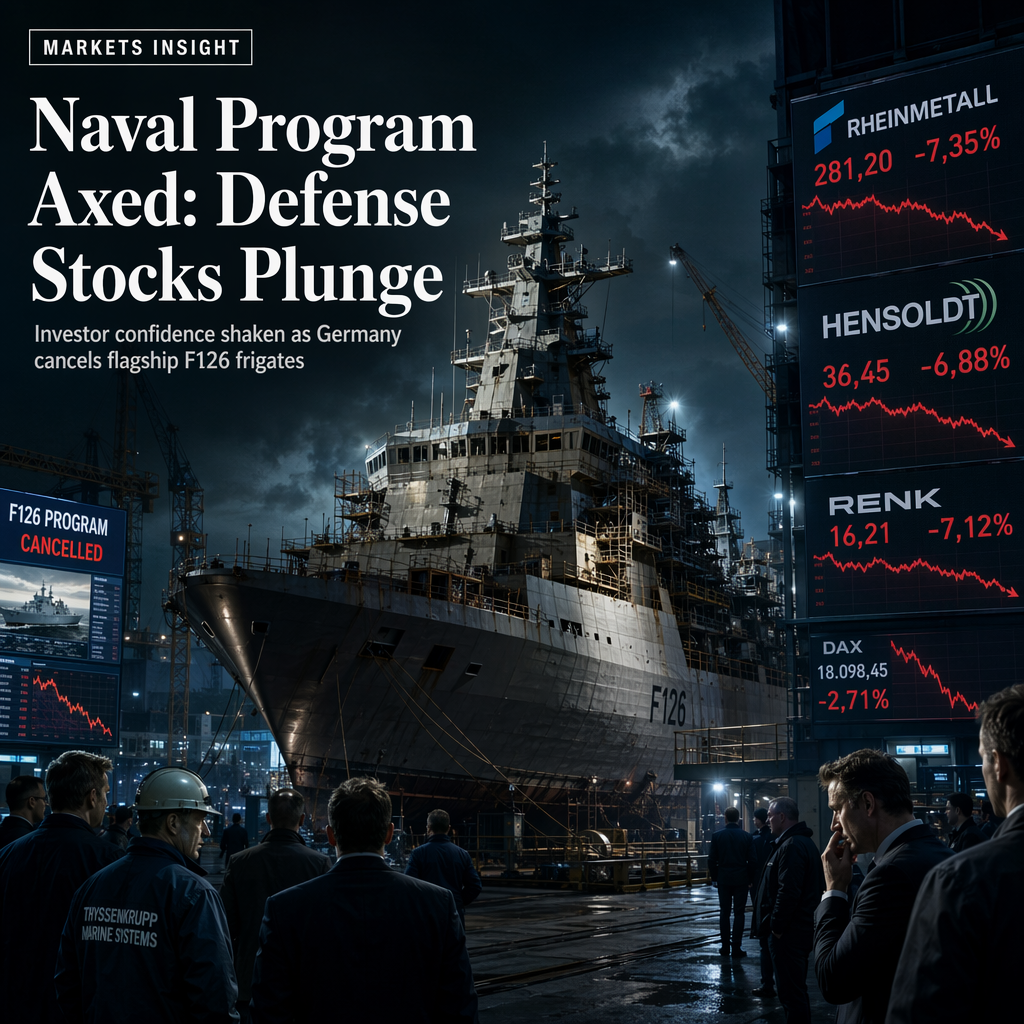
European defense stocks suffered significant losses following Germany's decision to cancel its flagship F126 naval program, a move that has shaken investor confidence in the region's rearmament boom [1]. Shares of Rheinmetall, which had been expected to become the lead contractor for the F126 program valued at more than 12 billion euros, fell 1% on Thursday after plunging 18% the previous day. German peers Hensoldt and Renk also dropped 3.5% and 1.7% respectively, extending their losses from the previous session [1]. Most major European defense companies traded in the red, with only Saab and Rolls-Royce posting modest gains of less than 1% [1].
Germany's abrupt U-turn on the F126 program underscores the political and unpredictable nature of government procurement in the defense sector. JP Morgan analysts, led by David Perry, highlighted that governments can change their priorities, impacting defense contractors' business assumptions. Perry's team cautioned that while they remain convinced Germany will continue substantial defense procurement over the next five years—particularly in land vehicles and ammunition from Rheinmetall—there is a risk that governments may shift spending to other areas such as drones, space, or advanced air defense systems [1].
The German government explained its decision by citing significant project delays, cost increases, and risks associated with changing the prime contractor to Rheinmetall. Instead, Germany will purchase eight smaller Meko A-200 frigates from TKMS, rather than the six larger F126 frigates. The Meko frigates are expected to fulfill the German Navy's core mission of anti-submarine warfare and meet NATO obligations [1].
Investor concerns have intensified regarding the reliability of large defense budgets promised by European and G7 countries, especially after NATO allies agreed last year to increase defense spending from 2% to 5% of GDP by 2025 [1]. The cancellation of the F126 program serves as a reminder that assumptions about future defense spending may not always materialize as expected.
CONCLUSION
Germany's cancellation of the F126 naval program has led to sharp declines in defense stocks, highlighting the sector's vulnerability to shifting government priorities. While analysts remain optimistic about future defense procurement, the event has increased uncertainty and reminded investors of the unpredictable nature of defense spending. The market takeaway is a heightened sense of caution regarding the reliability of promised defense budgets.