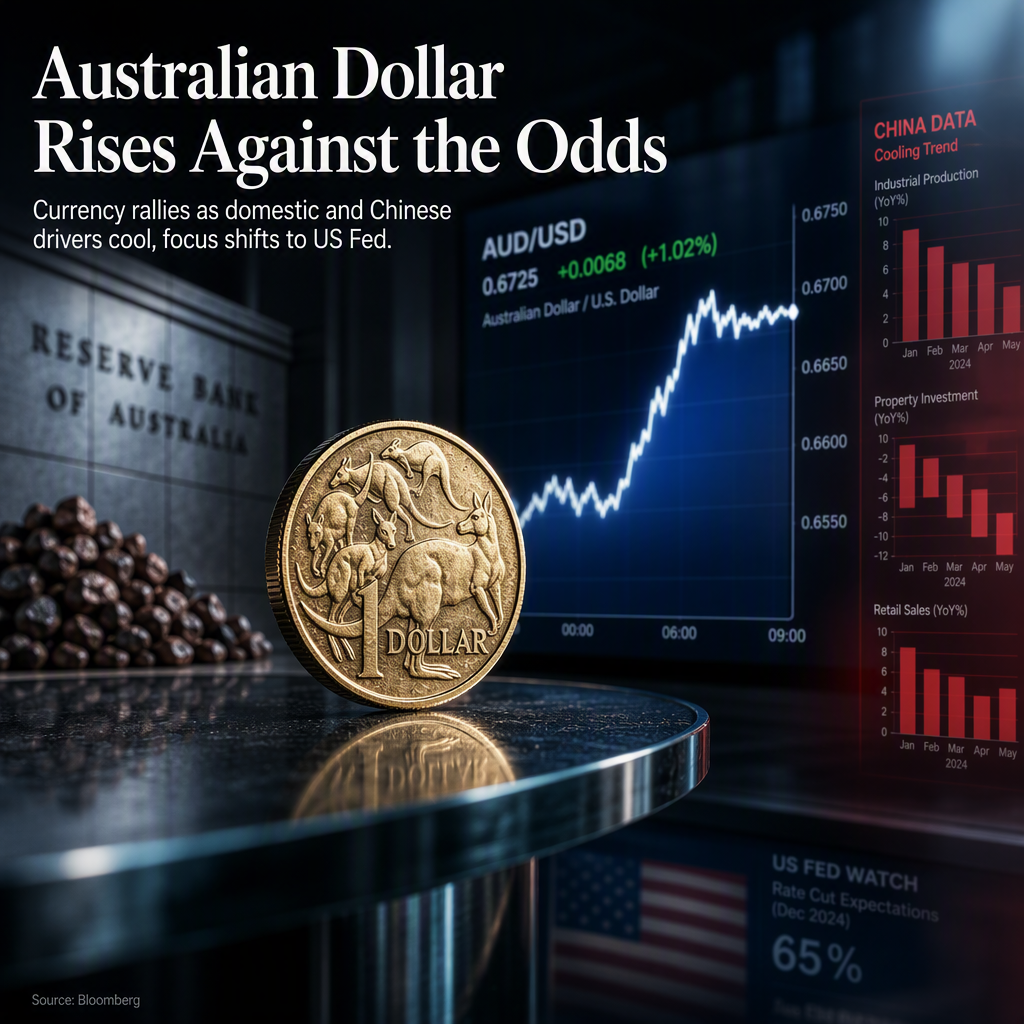
The Australian Dollar (AUD) has experienced a notable rally, trading in a narrow 20-pip range above 0.7050 and easing by 0.15% during the session, following a nearly 200-pip climb from its late-June low just above 0.6850. The 50-day Exponential Moving Average (EMA) was reclaimed and now sits flattened below the current price level, marking the tightest daily range in weeks for the currency pair [1].
Despite this upward movement, the rally lacks support from domestic Australian factors. Key domestic drivers have weakened: the upcoming Reserve Bank of Australia (RBA) rate decision is widely expected to result in no change, with a consensus and previous rate of 4.35%. A Reuters poll of 37 economists found no forecasts for a rate move, and market-implied odds of an increase are in the low single digits, down from a live possibility three weeks ago. This shift followed the June-quarter trimmed mean inflation print of 3.6%, which undershot expectations. Major domestic lenders have already concluded that 4.35% is the peak of the current rate cycle, and a hold would confirm this, potentially removing the last rate-based argument for owning the AUD [1].
Externally, China's July inflation data also pointed to cooling demand, with consumer prices falling 0.1% month-on-month against a 0.2% consensus, the annual rate slowing to 0.5% from 1% and missing the 0.8% forecast, and producer prices decelerating to 3.5% year-on-year from 4.1%. Iron ore prices have remained below $100 per tonne due to seaborne supply, compressed Chinese steel margins, and elevated port stocks, offering no support to the AUD through the terms-of-trade channel [1].
Given the lack of domestic and Chinese support, the article suggests that the recent AUD rally is primarily driven by movements on the US side of the currency pair, with market attention shifting to upcoming US Federal Reserve events [1].
CONCLUSION
The Australian Dollar's recent rally has occurred despite weakening domestic and Chinese economic indicators, with no rate hike expected from the RBA and subdued commodity prices. The move appears to be driven by external, particularly US-related, factors. Market participants are now focused on upcoming US Federal Reserve developments for further direction.