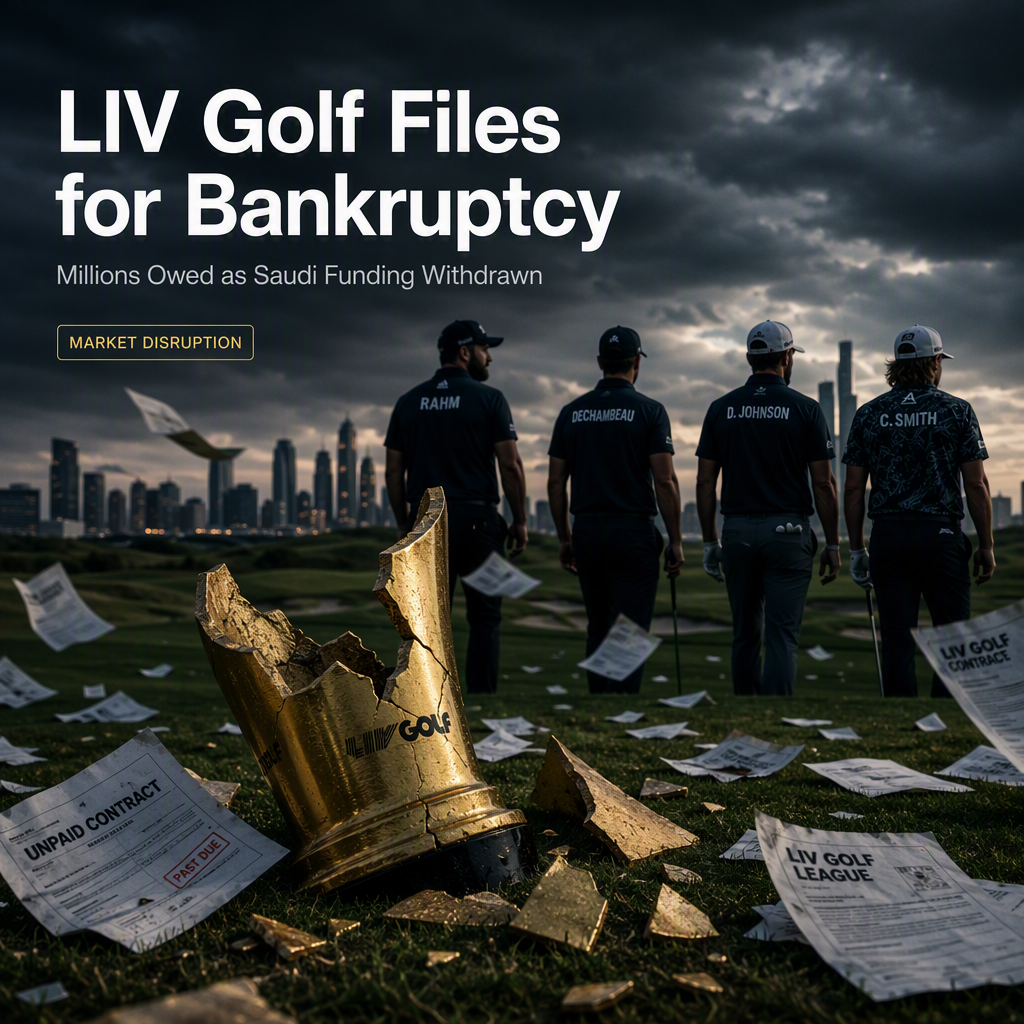
LIV Golf has filed for Chapter 11 bankruptcy protection in New Jersey, effectively suspending its current business model after five years of operations [1]. The bankruptcy filing comes in the wake of Saudi Arabia’s Public Investment Fund (PIF) halting financial support in April, a move attributed to the fund redirecting resources toward domestic projects and managing financial pressures stemming from the regional war with Iran [1]. PIF governor Yasir Al-Rumayyan subsequently resigned from LIV’s board [1].
Between 2021 and 2026, LIV Golf reportedly spent between $5 billion and $8 billion [1]. The bankruptcy filings reveal that the league owes millions of dollars in unpaid compensation to top players, including Jon Rahm, Bryson DeChambeau, Dustin Johnson, and Cam Smith [1]. Most operational staff have been laid off, event contractors are awaiting payment, and the organization faces a lawsuit from the Premier Golf League alleging breach of confidence and conspiracy [1].
To facilitate continued operations during bankruptcy, PIF provided $50 million to LIV Golf [1]. The league’s future hinges on a proposed restructuring plan called "LIV 2.0," which would see London-based private equity firm BC Partners—linked financially to player agency GSE Worldwide—fund a 2027 relaunch [1]. The plan proposes majority player ownership of the league and a new tournament format featuring 75-player fields, 72-hole events, cuts, Monday qualifiers, and a national team structure, closely resembling the traditional tour model [1]. LIV CEO Scott O’Neil outlined these changes as part of the reboot proposal [1].
Chapter 11 proceedings are expected to void existing player contracts, adding further uncertainty to the league’s future [1]. The organization, which entered professional golf with billions in backing, now faces bankruptcy, unpaid obligations, and an uncertain path forward [1].
CONCLUSION
LIV Golf’s bankruptcy filing marks a dramatic shift for the league, with millions owed to players and staff following the withdrawal of Saudi funding. The proposed restructuring plan offers a potential path forward, but the league’s future remains highly uncertain amid ongoing legal and financial challenges. Market sentiment is negative, reflecting the high-impact disruption to professional golf.