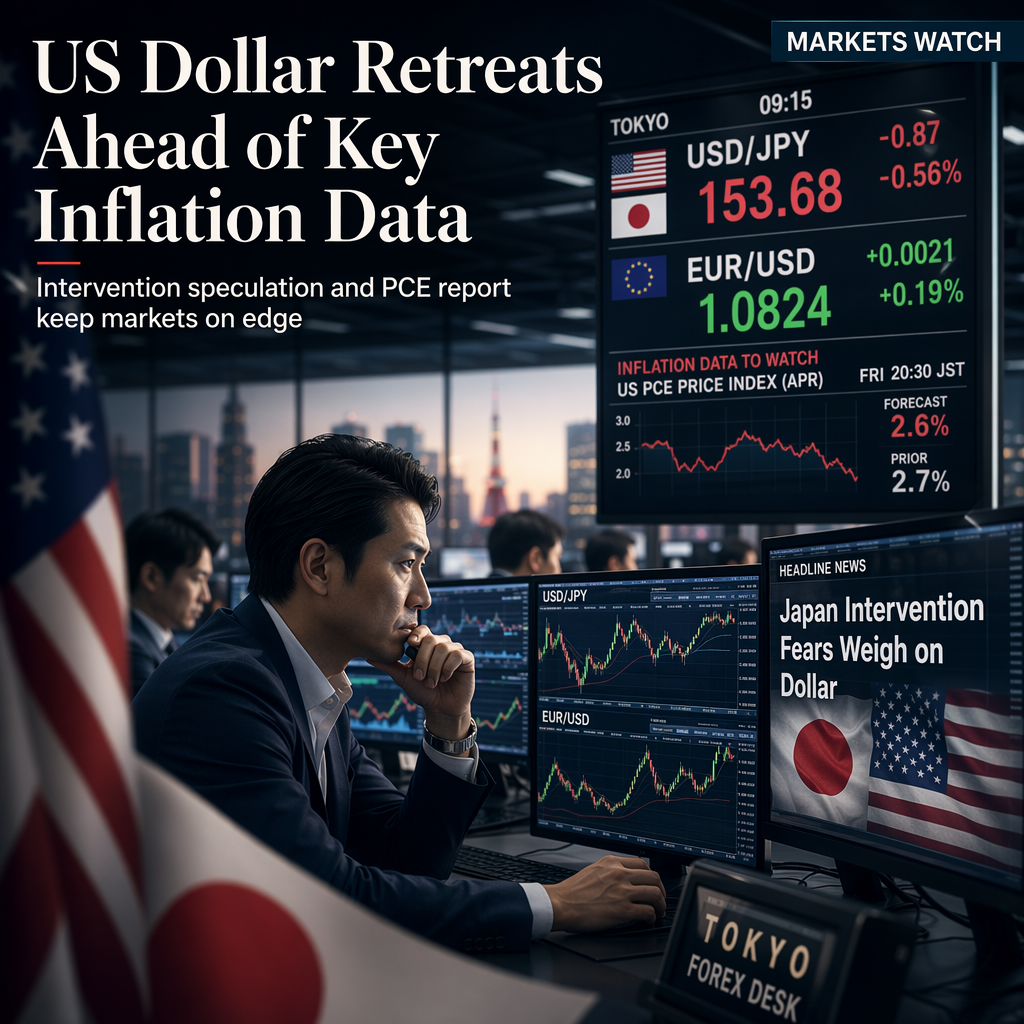
The US Dollar has experienced a modest pullback from its recent highs, with the USD/JPY pair edging lower during the Asian session on Thursday, finding support ahead of the 161.50 level. Despite this, spot prices remain close to a 40-year high, as traders await the US Personal Consumption Expenditures (PCE) Price Index for further direction. The outcome of this crucial inflation data is expected to influence the Federal Reserve's policy path and significantly impact USD price dynamics, potentially determining the next move for USD/JPY [1].
Recent declines in Crude Oil prices have eased inflationary concerns, prompting traders to scale back their bets on further Fed interest rate increases. This has contributed to the USD's pullback from its highest level since May 2025, reached on Wednesday, acting as a headwind for USD/JPY [1]. Additionally, heightened speculation about joint US-Japan intervention has offered support to the Japanese Yen and capped the upside for the currency pair. Japan's Finance Minister Satsuki Katayama and US Treasury Secretary Scott Bessent have agreed to take steps on currencies if necessary, while Japan’s Chief Cabinet Secretary Minoru Kihara stated that appropriate action would be taken against foreign exchange moves if needed. A hawkish Bank of Japan (BoJ) stance, with policymakers debating faster interest rate increases and board member Naoki Tamura advocating for a policy rate closer to the neutral level of about 2%, has also provided some respite to JPY bulls. However, the Fed's target rate remains higher at 3.5% to 3.75%, keeping the JPY carry trade in play and limiting USD/JPY downside [1].
Meanwhile, the EUR/USD pair is trading in positive territory around 1.1370 during the early European session on Thursday. A surprisingly hawkish message from Kevin Warsh as the new Fed chair last week has led traders to price in a US rate hike as soon as September. Markets are expected to turn cautious ahead of the US PCE report, with headline PCE anticipated to rise 4.1% year-over-year in May (versus 3.8% prior) and core PCE projected at 3.4% year-over-year (compared to 3.3% in April). If the data comes in hotter than expected, it could reinforce expectations of US interest rate hikes later this year and support the USD against the Euro [2].
Technical analysis indicates that EUR/USD remains decisively bearish, trading below key moving averages and only slightly above the lower Bollinger Band support at 1.1351. The Relative Strength Index (14) at 28.3 signals oversold conditions, but not a firm rebound. Immediate support is at 1.1350, with further losses possible toward 1.1300 if this level breaks. Resistance is seen at 1.1411, with stronger resistance at 1.1530 and 1.1650. Only a recovery above these levels would ease bearish pressure [2].
CONCLUSION
The US Dollar's recent pullback is driven by easing inflation concerns and intervention speculation, while anticipation of the US PCE inflation data is keeping markets cautious. Both USD/JPY and EUR/USD are positioned near key technical levels, with the outcome of the PCE report likely to dictate the next directional moves. Market sentiment remains mixed, with a medium impact expected as traders await further clarity from US inflation data and central bank policy signals.