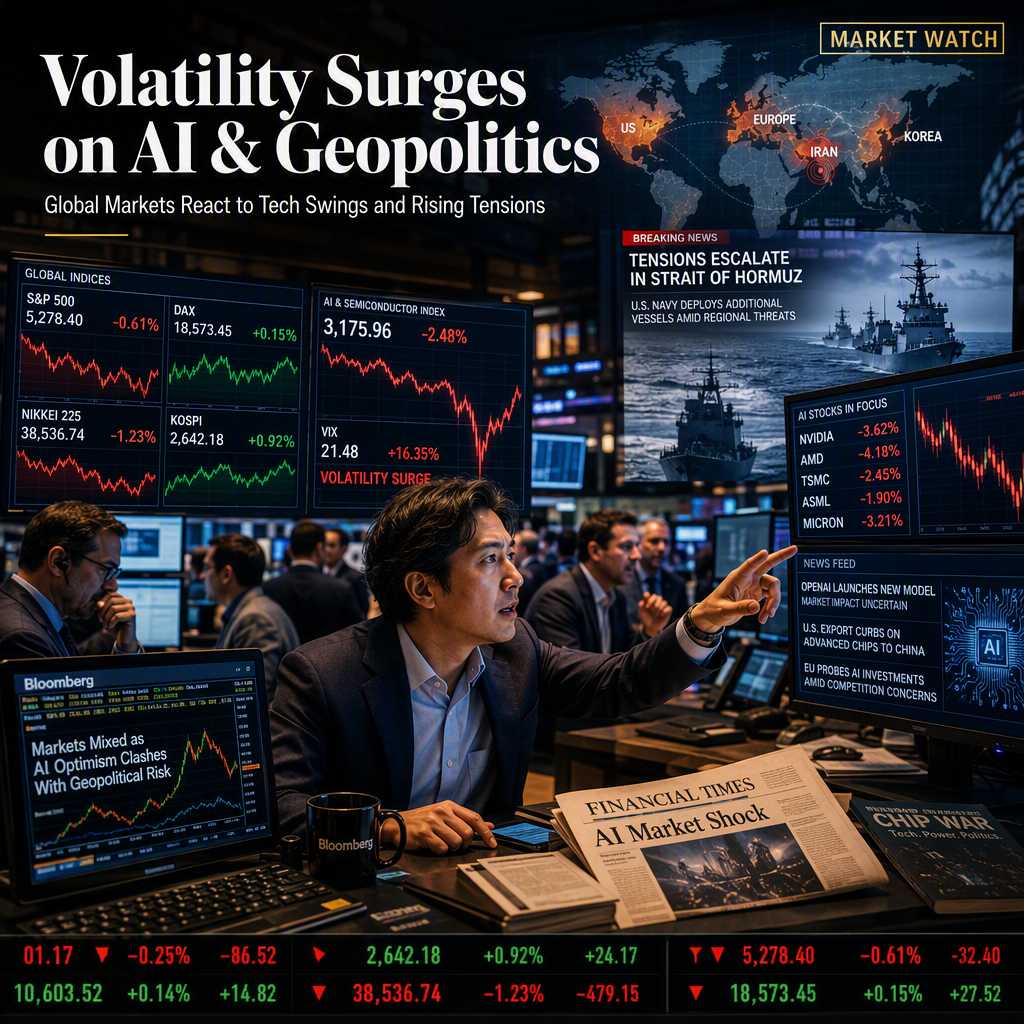
Global equity markets experienced significant volatility driven by a sharp reassessment of the artificial intelligence (AI) trade, according to Deutsche Bank strategists. The Philly Semiconductor index suffered its worst monthly decline since 2008, dropping -20.6%, while Korea's KOSPI slumped by -22.2% despite both indices remaining up over +50% year-to-date. European stocks outperformed, supported by sector rotation and solid Eurozone growth, with the DAX rising +2.11%, CAC +1.64%, and FTSE 100 +1.23%. The STOXX 600 advanced +0.73%, though ASML weighed on the index with a -8.24% decline [1].
US equities posted aggregate gains, with the S&P 500 advancing +1.05% (+0.70% Friday), and the Mag-7 group up +4.16% for the week. Microsoft surged +21.75% and Amazon +17.00% after earnings, while Apple fell -7.24% and Meta -6.47%. The Philly Semiconductor index ended the week -4.30% lower despite a +8.19% spike on Thursday. Internationally, Korea’s KOSPI saw a +17.91% surge on Friday but remained -1.42% lower for the week after earlier declines. S&P (+0.61%), Nasdaq (+0.96%), and Stoxx (+0.93%) futures rallied, although tech volatility continued to weigh on the KOSPI (-4.92%) and Nikkei (-0.93%) [1][2].
US stock futures rose as oil prices declined, driven by prospective diplomatic progress between Washington and Tehran. President Trump announced a pause on planned military strikes, claiming Iran and regional partners requested time to negotiate a deal to reopen the Strait of Hormuz and address Iran's nuclear program. However, Iranian officials refuted Washington’s characterization, calling it "nothing but a new lie" and maintaining high military alert, keeping geopolitical uncertainty elevated [2].
Investors are closely watching upcoming corporate earnings, with reports due from Palantir, SpaceX, AMD, Caterpillar, McDonald’s, Toyota, Eli Lilly, Walt Disney, Uber, Novo Nordisk, Siemens Energy, Siemens, Rheinmetall, SoftBank, and Nintendo. The US labor market data, especially Friday's monthly jobs report, is also expected to be a key catalyst. Deutsche Bank strategists emphasize that continued AI trade volatility is tempering broader US equity gains [1][2].
Additionally, Fed official Barkin's speech signaled a nuanced stance on interest rates, with remarks suggesting persistent but patchy inflation pressures and uncertainty about further tightening. This has kept Dollar bulls cautious and may limit aggressive Dollar repricing in the near term [2].
CONCLUSION
Global equities are experiencing heightened volatility due to a reassessment of the AI trade and ongoing geopolitical tensions, particularly between the US and Iran. While US and European indices have posted gains, tech sector swings and geopolitical uncertainty continue to weigh on markets. Investors are awaiting key corporate earnings and labor market data for further direction.