
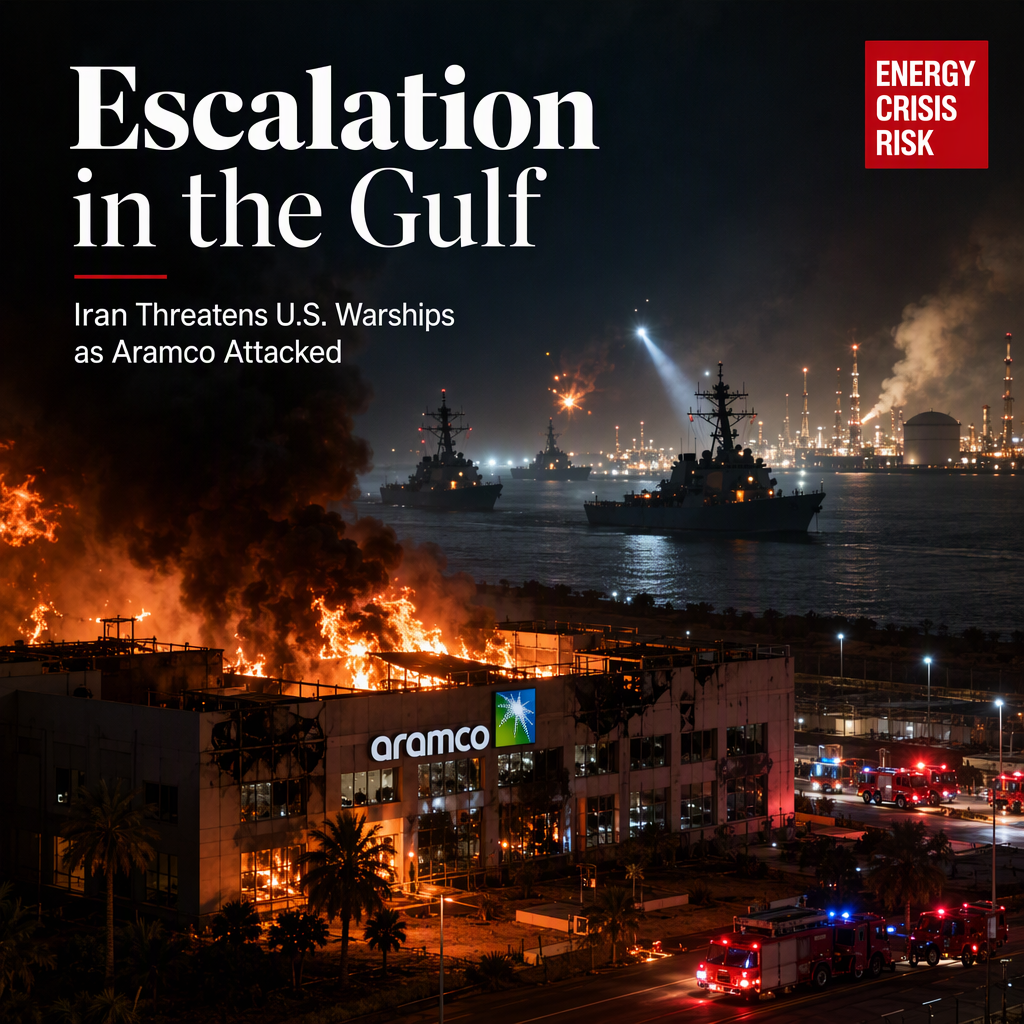
Tensions in the Middle East escalated sharply as Iran issued direct threats against U.S. warships and Saudi Aramco facilities came under attack. According to Saudi officials, an administrative building belonging to oil giant Saudi Aramco was targeted overnight by Houthi militants, resulting in a fire but no reported injuries in Dhahran on the eastern coast of Saudi Arabia [1]. The Houthis, a Yemen-based militia group backed by Iran, have intensified their attacks on Saudi targets over the past week, including airport strikes in Riyadh that led to multiple fatalities, flight cancellations, and property damage. King Khalid International Airport in Riyadh remains closed until Saturday [1].
The conflict in Yemen has reignited into full-scale fighting between the Houthis and the internationally recognized government, with the broader regional escalation tied to the ongoing U.S.–Iran war [1]. Iranian Islamic Revolutionary Guard Corps (IRGC) chief Ali Ozmaei declared that Tehran is 'counting the moments' until it can sink American warships, specifically threatening action in the Strait of Hormuz. Ozmaei stated, 'We are waiting for U.S. warships to approach the entrance to the Strait of Hormuz so we can sink them. We are counting down every moment until this happens' [1].
The Wall Street Journal reported that Iran has been bolstering defenses around sensitive sites, including nuclear facilities, and has warned regional officials that any new U.S. strikes will be met with retaliatory measures across the Middle East. Iran is reportedly preparing its population for renewed conflict in the coming weeks [1]. U.S. President Donald Trump stated that American forces would not attack Iran before the midterm election scheduled for November 3 [1].
On Wednesday, reports surfaced of a cargo ship catching fire and sinking in the Strait of Hormuz after allegedly hitting a naval mine, though CNBC could not independently verify these accounts. Later, the United Kingdom Maritime Trade Operations confirmed via a 'verified source' that a container ship had been struck by an 'unknown projectile' [1]. In response to Iranian claims of control over the Strait of Hormuz, U.S. Central Command asserted that American forces and regional partners maintain control, noting that over 19 million barrels of crude oil were shipped through the strait with U.S. assistance just the previous day [1].
CONCLUSION
The escalation of hostilities between Iran, the U.S., and regional actors has heightened risks for energy infrastructure and shipping in the Middle East. With direct threats against U.S. warships and attacks on Saudi Aramco facilities, market participants are likely to anticipate increased volatility in oil markets and regional security concerns. The situation remains fluid, with both sides signaling readiness for further escalation.