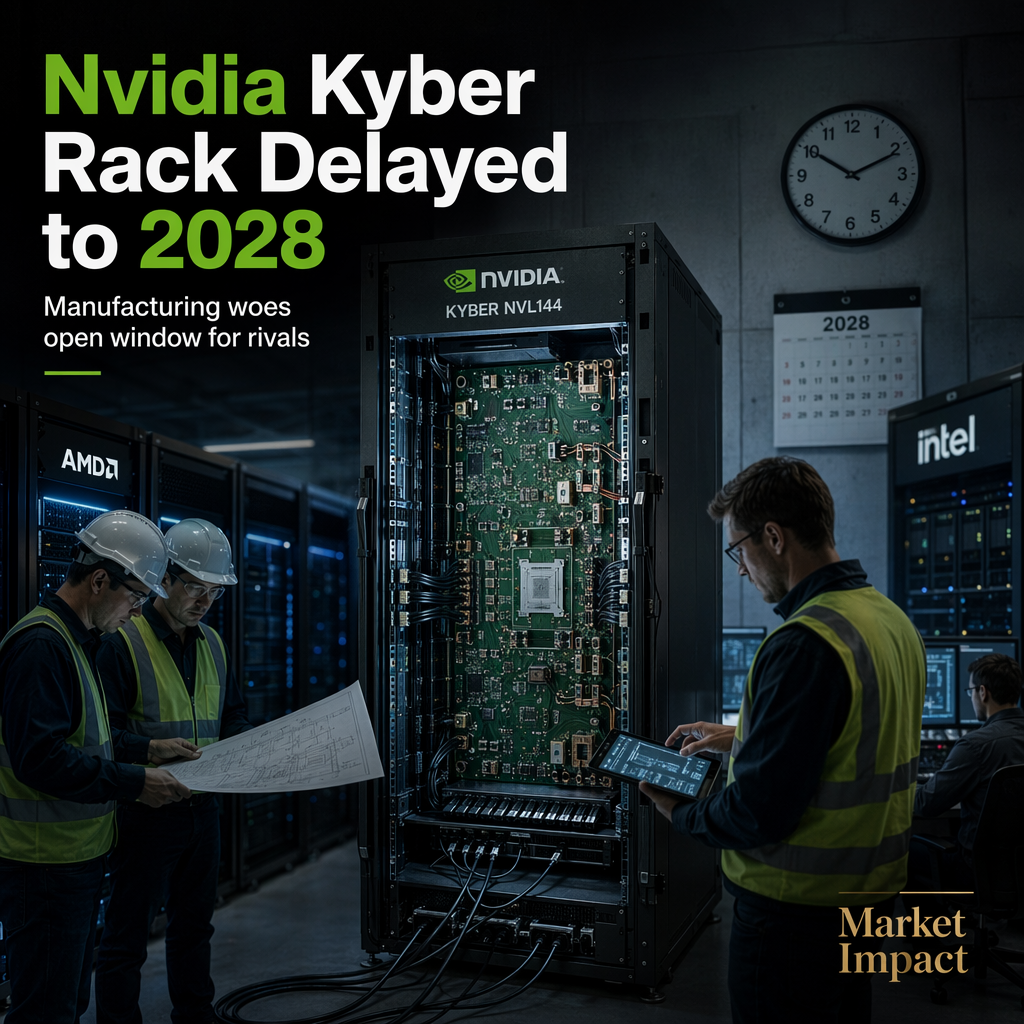
Nvidia's next-generation Kyber NVL144 rack system, designed to house its 2027 Rubin Ultra chips, has been delayed by more than 12 months to 2028 due to manufacturing difficulties with a key circuit board, according to research firm SemiAnalysis [1]. The Kyber system, which was intended to debut with the Vera Rubin Ultra rack-scale architecture in 2027, is a server cabinet that integrates 144 of Nvidia's most powerful chips into a single unit, significantly boosting computational density and reducing latency for advanced AI workloads [1].
The delay is attributed to challenges in manufacturing the specialized, multi-layer printed circuit board (PCB) midplane that connects electronic modules within the system. SemiAnalysis stated, 'Kyber NVL144 rack architecture has been delayed to 2028 as the PCB midplane remains challenging from a manufacturability standpoint.' Additionally, the larger NVL576 system, which links eight racks via optical connections, is also likely to face delays or be limited to small production volumes [1].
This setback intensifies concerns about Nvidia's aggressive annual product release schedule and its collision with manufacturing limits. A proposed backup plan to combine two current-generation racks for similar computational power was also cancelled after cloud service providers and hyperscalers rejected the design due to operational complexity and cost [1]. As a result, Nvidia currently lacks a proven solution to expand the scale-up world size for Rubin Ultra, which SemiAnalysis suggests could provide competitors such as AMD and Google with a rare technical opening at the high end of the AI hardware market [1].
Despite these challenges, Nvidia's current-generation Rubin systems remain in full production and are scheduled to begin shipping this fall to eight cloud partners, including Amazon Web Services, Microsoft Azure, and Google Cloud [1]. Nvidia did not respond to CNBC's request for comment on the reported delays [1].
CONCLUSION
Nvidia's delay of its Kyber rack system to 2028 due to manufacturing challenges raises concerns about its product roadmap and opens a window for competitors like AMD and Google. The lack of a viable backup solution and mounting operational hurdles could impact Nvidia's leadership in the high-end AI hardware market, despite ongoing shipments of its current-generation systems.