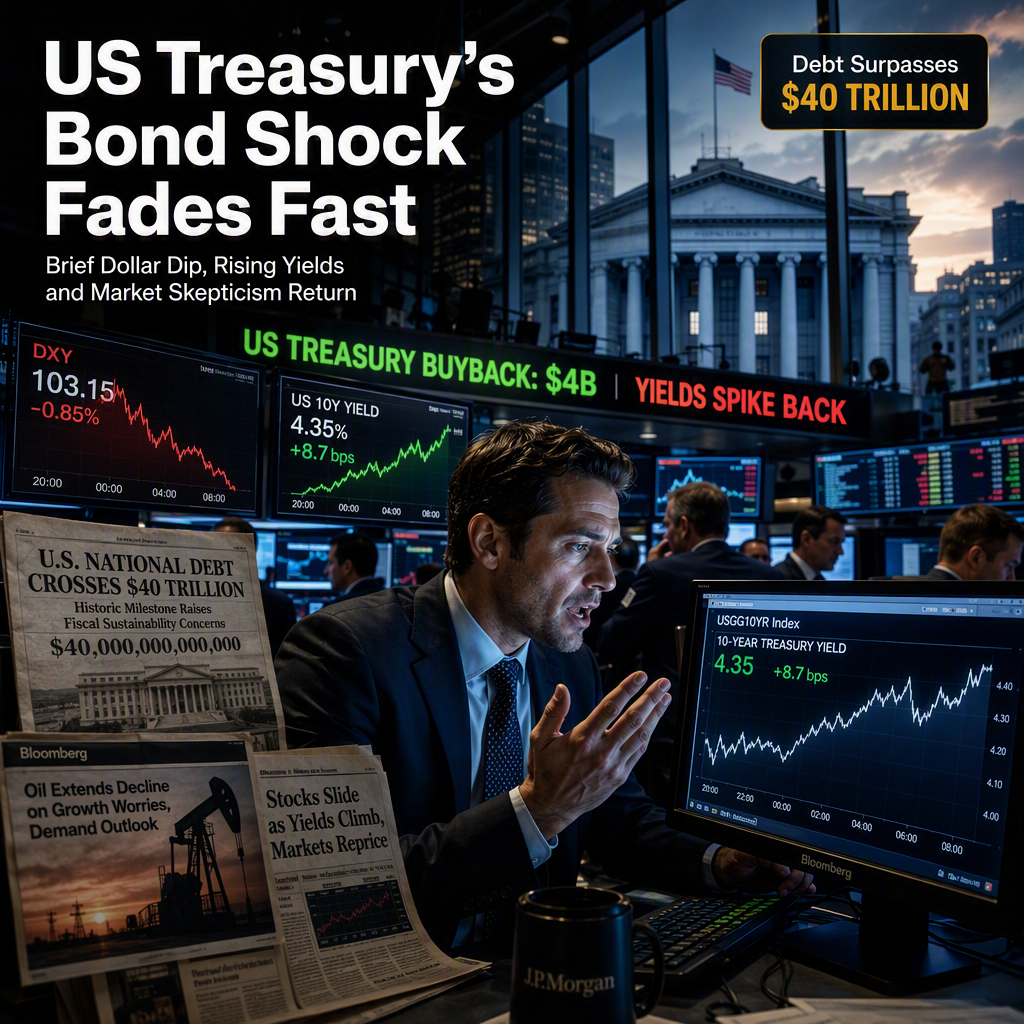
The US Treasury Department surprised markets by announcing a doubling of its long-end bond buybacks from $2 billion to $4 billion, aiming to push down long-term borrowing costs and address rising yields that have been exacerbating the US debt service and affordability crisis [1][4][5]. The immediate market reaction saw a sharp rally in Treasuries, with the 10-year yield dropping and the US Dollar (USD) weakening to its lowest level since mid-May, as the DXY index fell below 99 [1][4]. However, this relief proved short-lived. By Thursday morning, bond yields had rebounded, with the 10-year Treasury yield rising as high as 4.71% and the 30-year yield spiking to 5.627%, both returning to or exceeding pre-intervention levels [5].
Market participants and analysts expressed skepticism about the effectiveness and credibility of the Treasury's intervention. MUFG, UBS, and Brown Brothers Harriman (BBH) warned that the buyback, which is financed by short-term bill issuance, risks signaling official discomfort with rising borrowing costs and undermines US fiscal credibility, potentially opening new avenues for US Dollar weakness [1]. JPMorgan Chase's global rates team noted that, absent real fiscal consolidation, the move could contribute to higher term premiums and yields over time, especially if the Treasury appears to be moving away from its 'regular and predictable' debt management approach [5]. BBH strategists added that the timing of the buyback, coming soon after 30-year yields hit their highest since 2007, creates the perception that the Treasury is intervening to cap yields rather than simply improving liquidity, further eroding fiscal credibility [1].
DBS Group Research echoed the view that the additional buybacks are small in scale and that there has been no change in monetary policy, suggesting that the USD is more likely to consolidate rather than continue its decline in the immediate term [4]. Meanwhile, the FOMC's hawkish meeting minutes had little impact on markets compared to the Treasury's actions [4].
The Treasury's announcement also coincided with news that the outstanding national debt had surpassed $40 trillion for the first time, with interest payments on track to overtake Medicare as the government's largest expense [5]. Market watchers, including ING and Yardeni Research, described the intervention as highly unusual and unexpected, with some interpreting Treasury Secretary Scott Bessent's move as a signal of intent to keep a lid on bond yields at all costs [5].
The broader market reaction included a drop in US stock indices at the opening bell, with the S&P 500 down 0.3%, the Nasdaq Composite down 0.5%, and the Dow falling 400 points [5]. Oil prices also surged, with US crude briefly touching $89 per barrel and Brent nearing $95, partly in response to geopolitical tensions [5].
CONCLUSION
The US Treasury's unexpected expansion of long-end bond buybacks triggered a brief rally in Treasuries and a weaker US Dollar, but the effect quickly faded as yields rebounded and skepticism about the move's credibility grew. Analysts warn that without genuine fiscal consolidation, such interventions may undermine fiscal credibility and contribute to further market volatility. The episode highlights persistent concerns over US debt sustainability and the limits of policy-driven market interventions.