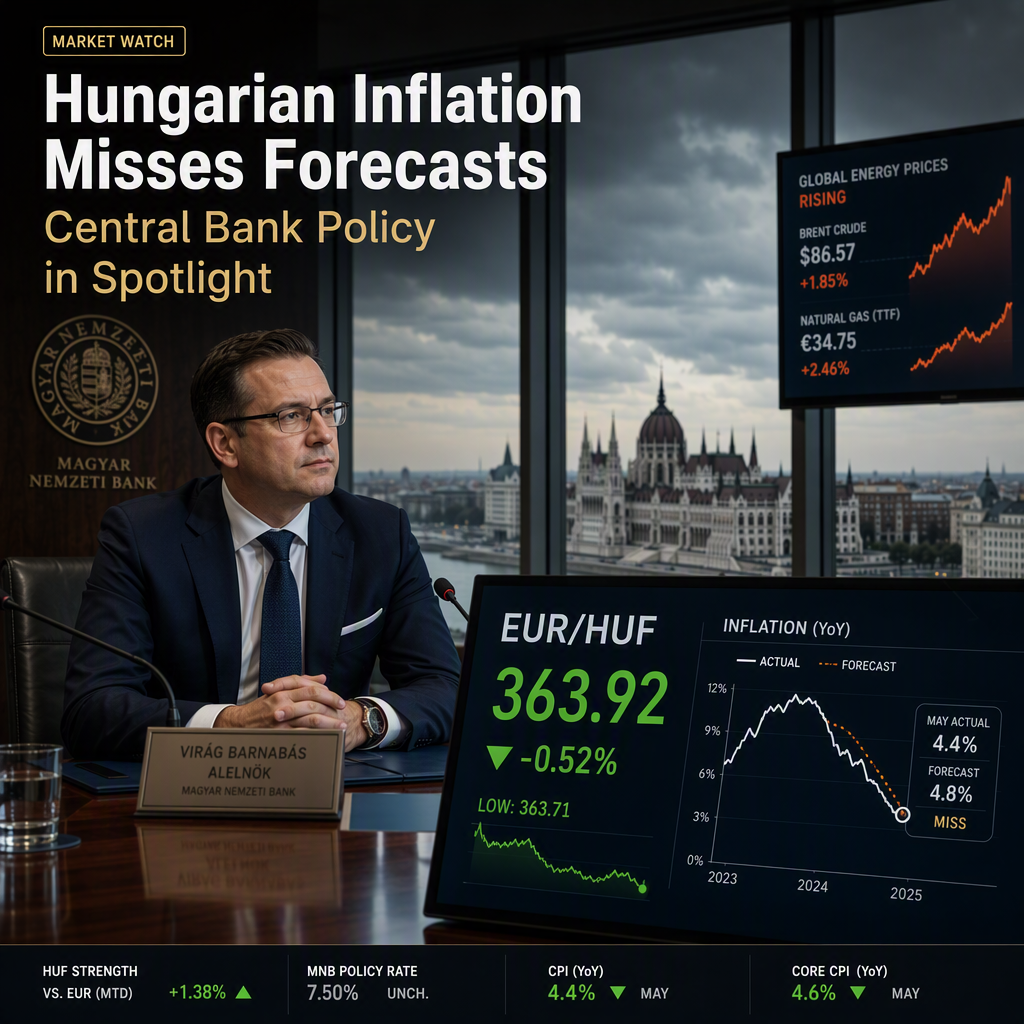
Hungarian inflation rebounded to 1.3% in August from 1.2% in July, which was the lowest reading in nearly a decade. However, the August figure remained below both market expectations and the National Bank of Hungary’s (NBH) forecast of 1.8%, resulting in a forecast miss of 0.5 percentage points, compared to a 0.7 percentage point miss in July [1]. ING’s Frantisek Taborsky notes that inflation is expected to stay below the central bank’s target for the remainder of the year [1].
Market attention has shifted to the NBH’s potential policy moves, especially after reports that the central bank may pause rate cuts in September to prepare for a lower inflation target ahead of Hungary’s euro adoption. However, NBH officials have indicated that any policy changes will likely be announced at the September meeting, coinciding with the release of a new forecast [1].
Following these developments, the Hungarian yield curve has flattened sharply and the forint has strengthened, trends that the latest inflation data are unlikely to reverse. The EUR/HUF exchange rate has dropped below 364, but ING warns that rising global energy prices could limit further forint gains and potentially push the exchange rate back above 364, given the forint’s recent high-beta behavior [1].
Analysts expect euro-area spreads to tighten further, but caution that higher gas and oil prices may act as a headwind for the forint’s recent strength [1].
CONCLUSION
Hungarian inflation remains subdued and below central bank forecasts, prompting market speculation about a potential pause in rate cuts. While the forint has recently strengthened, rising energy prices could limit further gains and impact the currency’s trajectory. Investors are now focused on the NBH’s September meeting for clearer policy direction.