
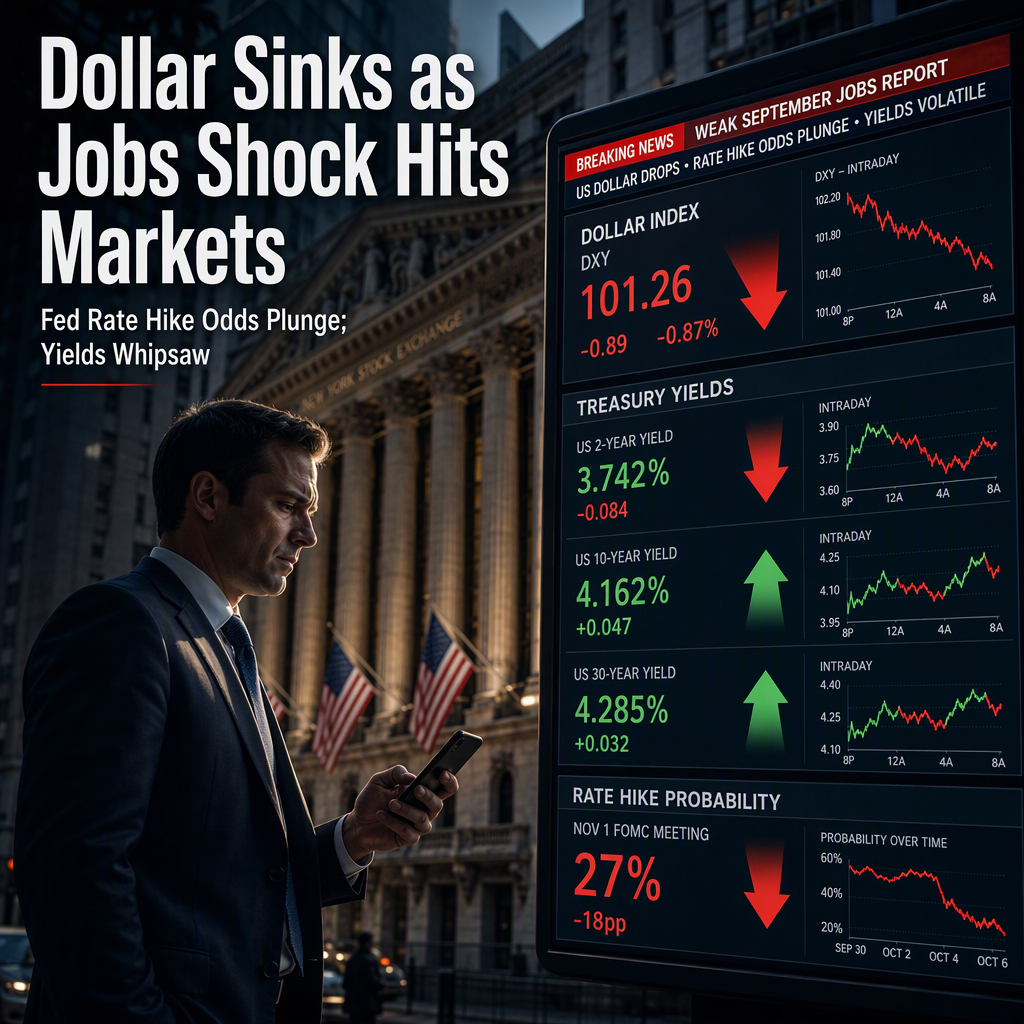
The US labor market delivered a significant surprise in September, with Nonfarm Payrolls (NFP) increasing by only 29,000, far below market expectations of 84,000–90,000 jobs added [1][2][3][4]. The Bureau of Labor Statistics also revised previous months' data downward: August job creation was cut to 133,000 from 162,000, and July was revised to a 10,000 job loss from a previously estimated 21,000 gain, resulting in a combined downward revision of 60,000 jobs for July and August [1][2][4]. The unemployment rate edged up to 4.2% from 4.1%, while the labor force participation rate rose to 61.8% from 61.6% [1][4]. Average hourly earnings increased 3.0% year-over-year, below the 3.2% forecast, easing concerns about wage-driven inflation [1][2].
The US Dollar Index (DXY) reacted negatively, dropping below 102.00 and trading near 101.90 after the report, as the weaker jobs data and downward revisions weighed on the Greenback [1][2]. The two-year Treasury yield, which is sensitive to Federal Reserve policy expectations, initially fell but later rose by more than 3 basis points to 4.818%, while the benchmark 10-year Treasury yield increased by 2 basis points to 5.26% [2][4]. Yields initially dropped on the weak jobs print but recovered throughout the session, reflecting ongoing uncertainty about the Fed's next moves [4].
Market expectations for a Federal Reserve rate hike in October shifted dramatically. According to the CME FedWatch tool, the probability of an October rate hike fell to around 17–22%, down from 36–64% a week earlier [1][3][4]. On the Kalshi prediction market, the odds dropped from almost 70% to just 18% [3]. However, traders still see a high likelihood of a rate hike at the Fed's December meeting, with probabilities ranging from 65% to above 75% depending on the platform [1][3][4].
Analysts offered mixed views on the implications. Adam Schickling, senior economist at Vanguard, stated, "This report strengthens the case for the Federal Reserve to remain patient," noting that while the labor market hasn't deteriorated sharply, there is little evidence of meaningful strengthening [3]. Lindsay Rosner of Goldman Sachs Asset Management commented that the soft jobs print argues against a retightening labor market, but maintained that a December hike remains the base case, though market and energy price pressures could still influence the Fed's decision [4]. Timothy Chubb of Girard Advisory Services suggested that the report does not fundamentally change the Fed's trajectory, which he sees as "higher for longer" [4].
In related currency markets, the New Zealand Dollar (NZD/USD) rebounded to around 0.5610, up 0.12% on the day, benefiting from the US Dollar's weakness. However, political uncertainty ahead of New Zealand's November 7 election limited the Kiwi's gains, with potential changes to the Reserve Bank of New Zealand's mandate adding to market caution [1].
CONCLUSION
September's sharply weaker US jobs report triggered a notable drop in the US Dollar and a swift repricing of Federal Reserve rate hike expectations, with an October hike now seen as highly unlikely. Treasury yields were volatile but ultimately rose, reflecting persistent uncertainty about the Fed's path. Markets are now focused on the December FOMC meeting, where a rate hike is still widely anticipated.