
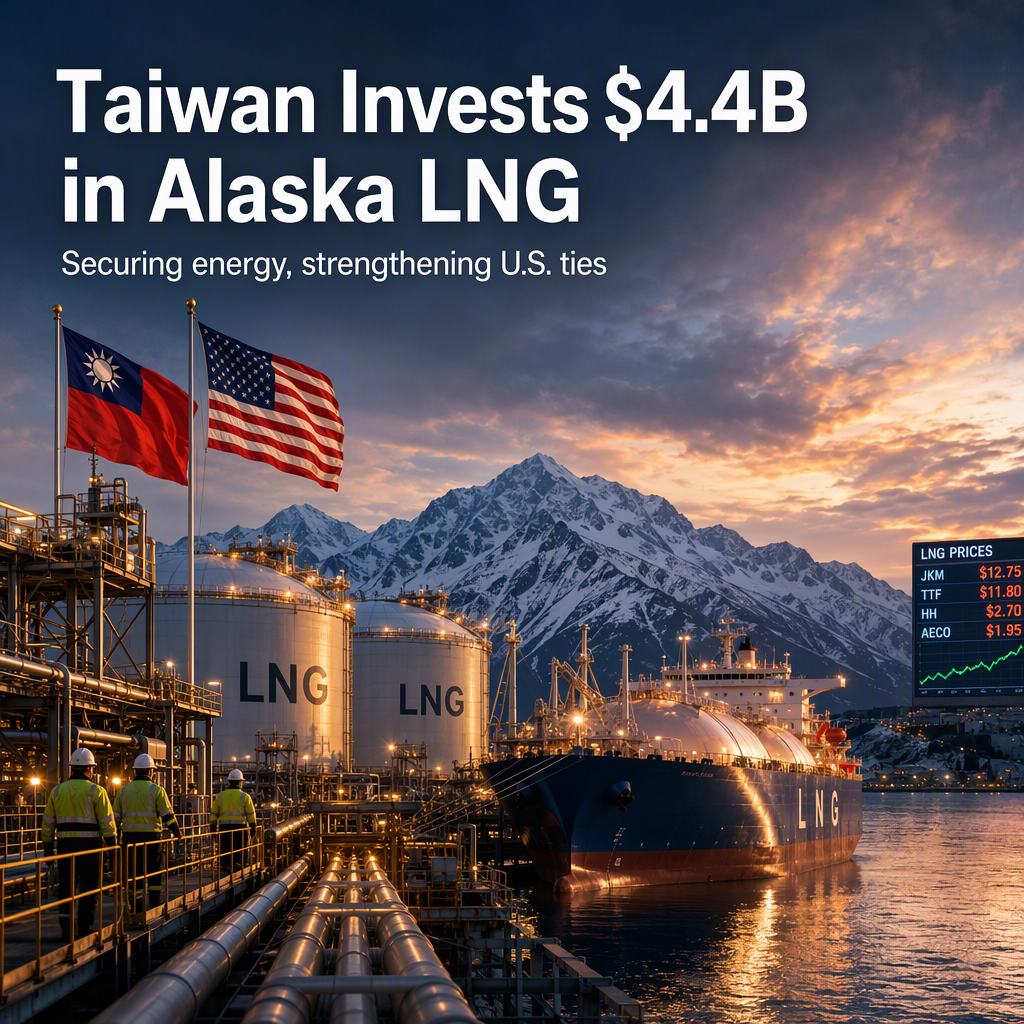
Taiwan has confirmed plans to purchase liquefied natural gas (LNG) from a proposed project in Alaska, marking a significant step in energy cooperation between Taiwan and the United States. The deal, announced amid heightened tensions and concerns over energy security, involves a $4.4 billion investment by Taiwan's economy ministry and annual purchases estimated at 6 million tons from the Alaska LNG project [1]. U.S. President Donald Trump highlighted the agreement during a rally in Wasilla, Alaska on October 13, describing it as a 'win-win for both Alaska and Taiwan' and emphasizing the economic benefits for the U.S. state as well as the critical support for Taiwan's energy needs [1].
The partnership is seen as a strategic response to recent global instability, including the Iran war and the Hormuz crisis, which exposed vulnerabilities in Taiwan's energy supply chains [1]. Officials in Taipei have stated that the Alaska LNG project will provide Taiwan with a reliable source of LNG, reducing its dependence on other suppliers and enhancing its energy resilience [1]. The project is expected to become a cornerstone of Taiwan's energy strategy in the coming years, with the financial commitment underscoring Taiwan's intent to secure long-term energy supplies [1].
Market analysts suggest that the deal could have ripple effects on global LNG prices, potentially influencing price levels and supply contracts across Asia [1]. Observers are closely monitoring the LNG sector for technical indicators and price movements following this announcement [1].
Taiwan's energy ministry is expected to finalize the investment and purchase agreements in the coming months, with further details anticipated as negotiations progress [1].
CONCLUSION
Taiwan's $4.4 billion commitment to the Alaska LNG project signals a major shift in its energy strategy and strengthens ties with the U.S. The deal is expected to impact global LNG markets and enhance Taiwan's energy security. Market participants are watching for further developments and potential price movements in the LNG sector.