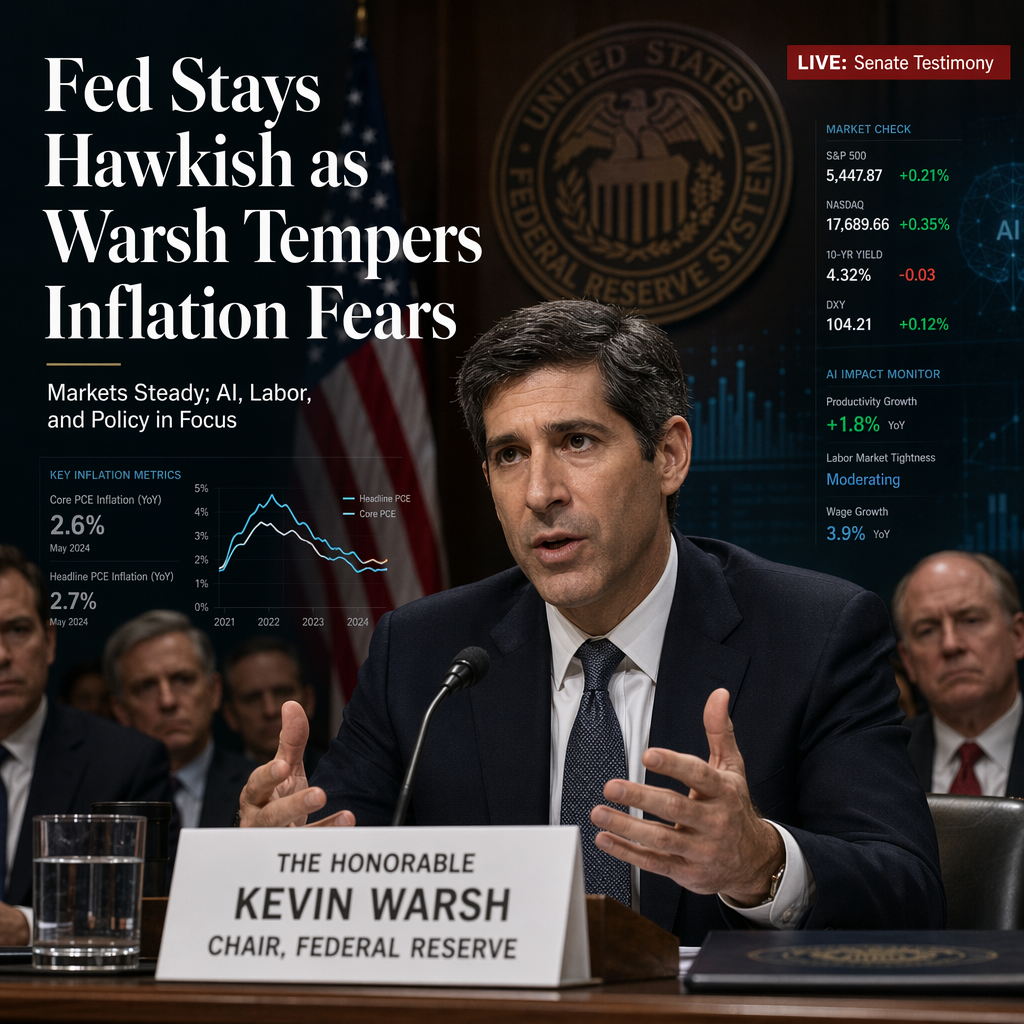
Federal Reserve Chair Kevin Warsh testified before the US Senate Committee on Banking, Housing and Urban Affairs, stating that current inflation pressures will not be permanent, though he acknowledged that the latest inflation measures remain unsatisfactory [1]. Warsh attributed some of the inflation to monetary policy and noted that the labor market remains in good shape, describing it as broadly balanced and undergoing significant structural change [1]. He also indicated uncertainty regarding whether previous interest rate cuts were responsible for the labor market’s resilience [1].
Warsh emphasized that none of the current inflation measures are satisfactory and described recent inflation data as an 'imperfect gauge of underlying inflation' [1]. He highlighted the role of artificial intelligence (AI) as a long-term driver for jobs and wages, while acknowledging near-term disruptions and the challenge of translating productivity gains into wage growth [1]. Warsh stated that whether AI proves inflationary is 'up to the Fed,' reinforcing the central bank’s policy primacy [1].
The FXS Speechtracker rated Warsh’s testimony at 5.4/10, which is softer than the historical average of 7/10, indicating a more nuanced and less forceful tone [1]. Despite this, the FXS Fed Sentiment Index remained unchanged at 126.13, a still-elevated level, suggesting that Warsh’s remarks did not materially shift market perceptions of the Fed’s stance, and the US Dollar remains supported by the prevailing hawkish policy backdrop [1].
Looking ahead, Warsh mentioned that the Federal Reserve is expected to receive taskforce briefings in early September, and he reiterated that there is no fixed limit to how quickly the US economy can grow [1].
CONCLUSION
Fed Chair Warsh’s testimony signaled that while inflation remains a concern, it is not expected to be permanent. The market interpreted his remarks as maintaining the current hawkish policy stance, with no immediate shift in expectations for US monetary policy. The US Dollar remains supported by the Fed’s prevailing outlook.