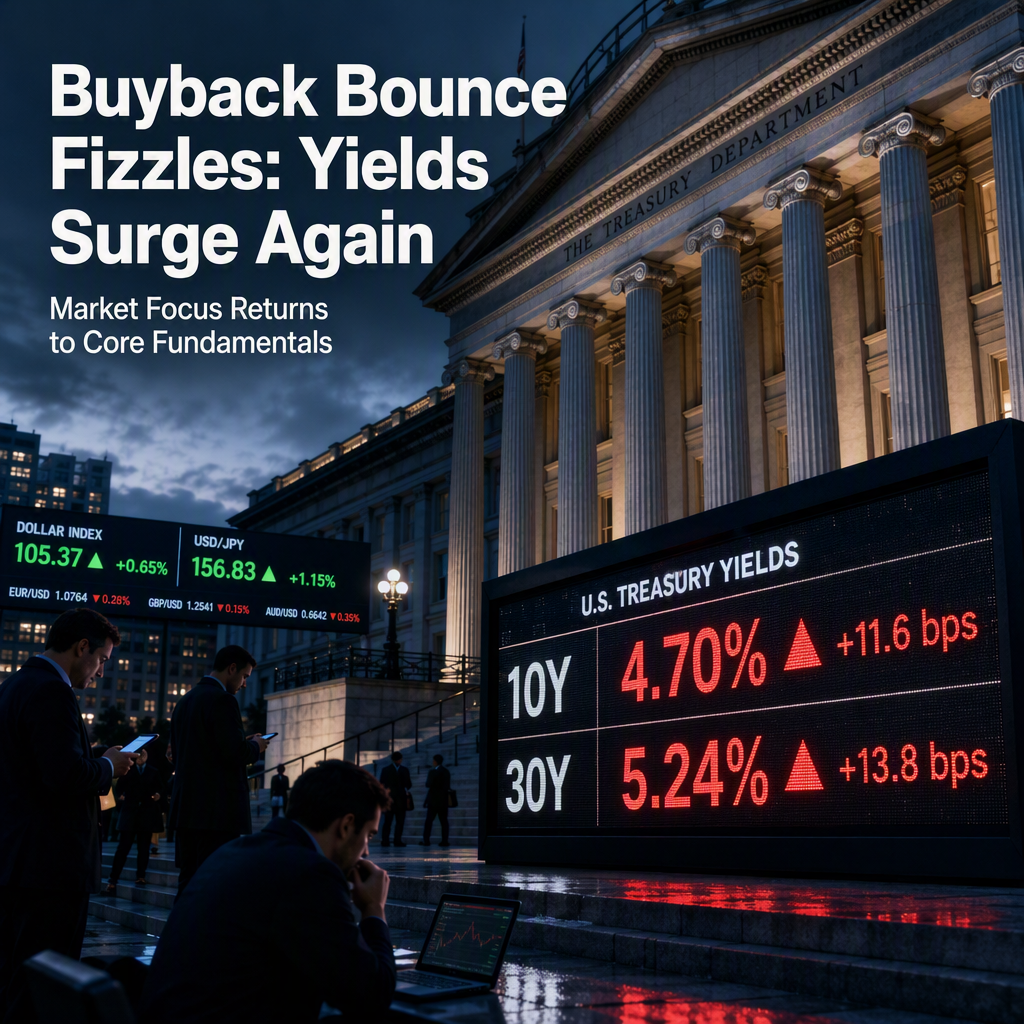
The US Treasury Department's unexpected decision to increase buybacks of longer-term bonds briefly interrupted the upward trajectory of US Treasury yields, but this effect proved short-lived, according to Rabobank's Senior US Strategist Philip Marey [1]. Marey emphasized that core macroeconomic drivers—such as elevated inflation, widening budget deficits, and strong AI-related investment demand—remain unchanged, limiting the effectiveness of the Treasury's intervention [1]. He further noted that the unpredictability introduced by these buybacks could increase market volatility and potentially force investors to demand higher risk premiums on Treasury yields [1].
MUFG's Michael Wan corroborated that US longer-end yields have already returned to near pre-buyback levels, with the 10-year yield at 4.7% and the 30-year at 5.24%, which has weighed on risk assets [2]. Wan highlighted that, from a foreign exchange perspective, the Dollar Index (DXY) initially declined but later rebounded, primarily due to Japanese Yen underperformance. The USD/JPY pair approached 159, and EUR/JPY rose toward 185.71, despite recent joint FX intervention between the US and Japan on July 30 [2].
Both analysts underscored that recent interventions—whether in the US Treasury market or the Japanese Yen—have failed to produce lasting changes in market trends, with asset prices reverting to levels seen before the interventions [1][2]. Marey warned that the Treasury's buyback program is constrained by the debt ceiling and limited funding, suggesting that its ability to influence yields is temporary at best [1]. Wan and the MUFG global team echoed the sentiment that for interventions to have a sustained impact, underlying macroeconomic fundamentals must shift [2].
The articles did not provide specific dates for the Treasury's buyback announcement or the exact amounts involved, nor did they mention any analyst forecasts or forward-looking projections beyond the general view that fundamentals are paramount [1][2].
CONCLUSION
Both Rabobank and MUFG agree that the US Treasury's buyback intervention has not altered the upward trend in yields, with market levels quickly reverting to pre-intervention norms. The consensus is that without a change in core macroeconomic fundamentals, such interventions are unlikely to have a lasting impact on rates or FX markets.