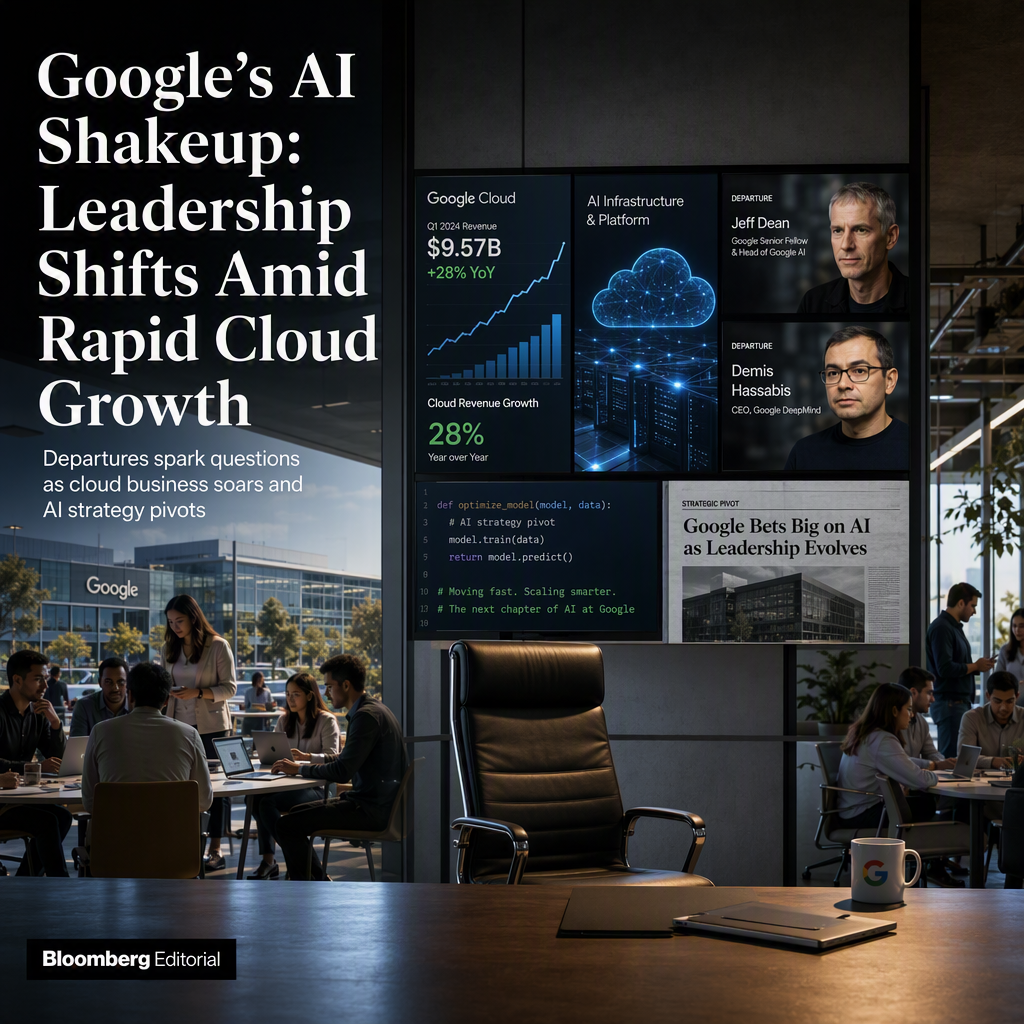
Google is undergoing significant changes in its artificial intelligence (AI) leadership as the company experiences rapid growth in its cloud business. The departure of chief scientist Jeff Dean after 27 years and Demis Hassabis stepping down from daily management of DeepMind to become chairman have raised questions about Google's ability to retain top AI talent and maintain its position at the forefront of AI innovation [1]. These leadership changes come on the heels of Google's cloud division reporting an impressive 82% revenue growth in the second quarter, outpacing rival offerings from Amazon and Microsoft [1].
The company's strategic focus appears to be shifting toward infrastructure, efficient models, and enterprise AI services, as evidenced by Alphabet CEO Sundar Pichai's statement that 90% of Fortune 100 companies are using Gemini Enterprise, Google's AI service for cloud customers [1]. This pivot is supported by industry voices such as Tomasz Tunguz, founder of Theory Ventures, who noted that top-tier AI models are not always necessary for most enterprise needs, suggesting that 'reasonable' models suffice for many white-collar applications [1].
Despite the positive momentum in the cloud sector, Alphabet shares experienced a decline following the latest earnings report, driven by concerns over capital expenditures and further exacerbated by the announcements regarding Dean and Hassabis [1]. Internally, some Google researchers have expressed frustration over limited access to computing resources for ambitious projects, while observing that Google Cloud is selling its proprietary tensor processing units (TPUs) to external customers, including Anthropic [1].
Google's full-stack approach to AI contributed to a 16% rise in its stock price this year, following a 65% jump in 2025 when it outperformed all other megacap peers [1]. However, the recent leadership changes and internal tensions highlight the challenges Google faces in balancing investment in frontier AI research with the commercial success of its cloud business [1].
CONCLUSION
Google's rapid cloud growth and strategic focus on enterprise AI services have boosted its market position, but recent leadership departures and internal frustrations signal challenges ahead. While Wall Street sentiment remains generally positive, concerns about capital expenditures and talent retention could impact Google's ability to lead in AI innovation.