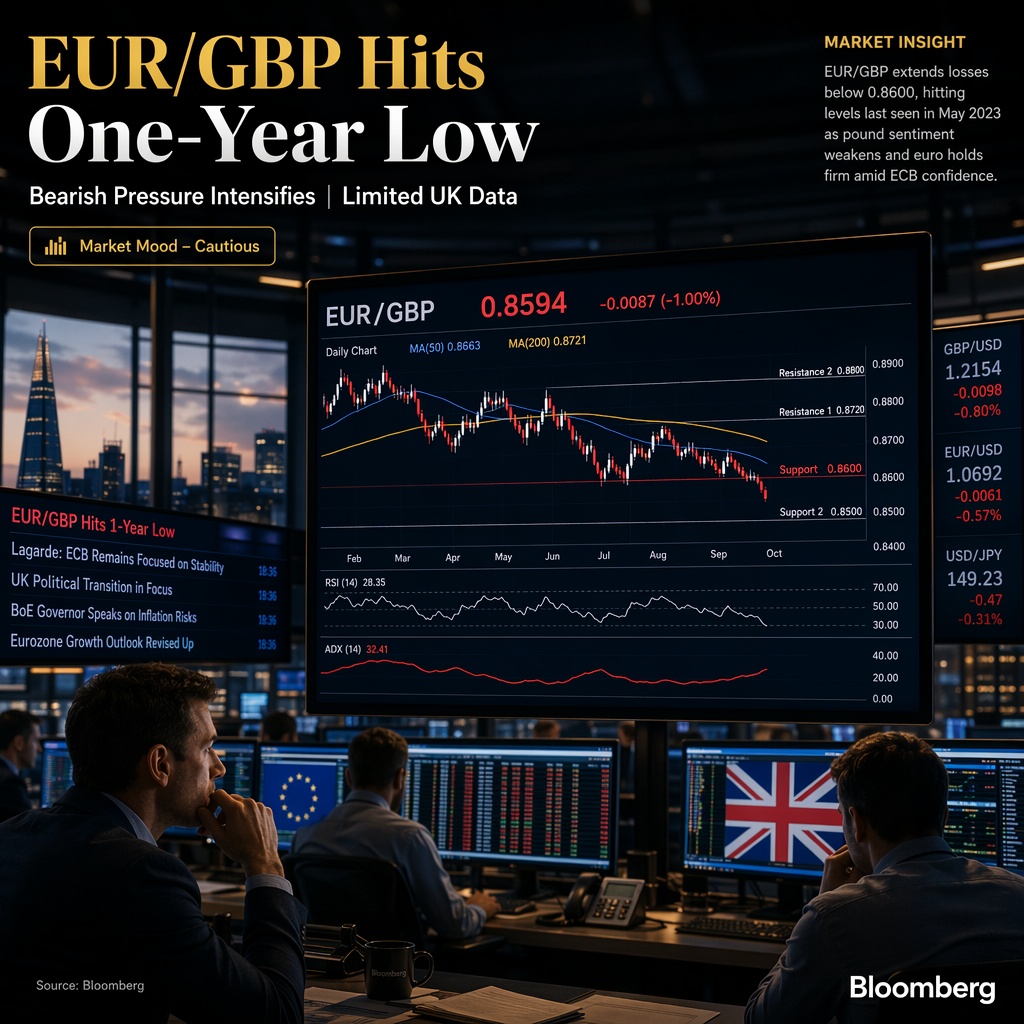
The EUR/GBP currency pair recently dropped to its lowest level since June 2025, trading around 0.8550 after rebounding from an intraday low of 0.8533. This decline followed a break below the key 0.8600 support level, intensifying selling pressure and reinforcing a bearish outlook for the pair. Technical indicators, including the Relative Strength Index (RSI) and Average Directional Index (ADX), suggest that while the pair has bounced from oversold territory, the downtrend remains weak but persistent. Resistance is noted at 0.8600, with further caps at the 100-day and 200-day Simple Moving Averages (0.8664 and 0.8696, respectively), while the next significant support lies at 0.8500. A break below this level could extend the bearish sequence toward new lows, despite a tentative improvement in momentum [1].
The economic calendar is relatively light in Europe this week, shifting market focus to comments from central bank officials. ECB Governing Council member Fabio Panetta described the outlook as 'fragile,' citing ongoing upside inflation and downside growth risks. Market participants are also awaiting remarks from BoE policymaker Catherine Mann for further policy direction [1].
In parallel, the British Pound (GBP) has shown softness against the US Dollar (USD), declining by 0.1% after encountering resistance near 1.3400. Scotiabank strategists highlight that GBP/USD is likely to remain range-bound between 1.3350 and 1.3450 in the near term, with multiple resistance levels capping upside momentum. The RSI's recovery above the neutral threshold at 50 indicates improving momentum, but the 50- and 200-day moving averages around 1.3400 continue to act as resistance. The lack of significant new data or Bank of England developments, aside from media reports on potential easing of bank capital rules, has contributed to the subdued market action. Political uncertainty persists as markets await further news on the leadership transition from PM Starmer to the 'leader-in-waiting' Burnham. The UK's Office for Budget Responsibility (OBR) has highlighted fiscal challenges, specifically the £100bn cost of stabilizing national debt at 95% of GDP [2].
Overall, both EUR/GBP and GBP/USD are experiencing constrained trading conditions, with technical resistance levels and a lack of fresh economic data limiting directional moves. Market participants remain attentive to central bank commentary and political developments for potential catalysts.
CONCLUSION
EUR/GBP remains under bearish pressure after breaking key support, while GBP/USD is range-bound amid limited data and persistent resistance. Market sentiment is cautious, with traders awaiting central bank signals and political updates. Fiscal risks and technical barriers continue to shape the outlook for both currency pairs.