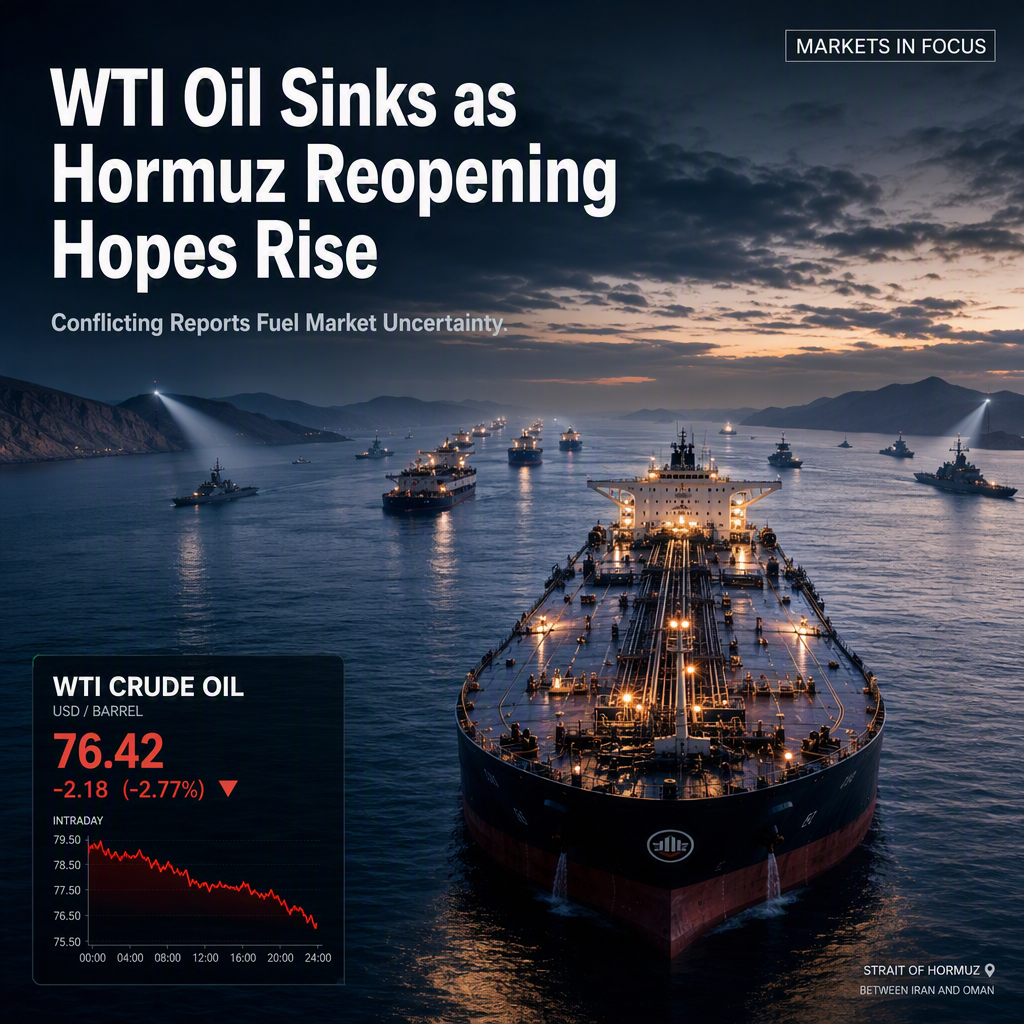
West Texas Intermediate (WTI) futures on NYMEX traded 0.45% lower, hovering near $74 during the early European session on Thursday, approaching a three-week low of $73.51 recorded the previous day [1]. The decline in oil prices is attributed to growing expectations that the Strait of Hormuz, a critical passage for nearly 20% of global energy supply, may soon reopen [1]. This sentiment is supported by statements from Iran’s Foreign Ministry spokesperson, Esmaeil Baghaei, who indicated that Iran and Oman are close to finalizing a framework to manage navigation through the strait [1]. Additionally, a senior Gulf official estimated a 50% chance that Iran and Oman will reach an agreement by Friday [1].
Market participants are closely monitoring reactions from global leaders, particularly as the United States has condemned Iran’s intentions to seek recognition of its authority near the Hormuz [1]. Contradictory headlines emerged when US President Donald Trump posted on Truth Social over the weekend, claiming that Iran had agreed to an “Immediate, Complete, and Total opening of the Hormuz Strait” [1]. However, this assertion is at odds with ongoing negotiations and the 50% probability cited by Gulf officials [1].
From a technical perspective, WTI maintains a bearish near-term bias, trading well below the 20-day exponential moving average (EMA) at $79.24, which now acts as the primary resistance level [1]. The Relative Strength Index (RSI) is around 42, indicating neutral-to-soft selling pressure [1]. Analysts expect the price to extend its decline toward $70, with a decisive break below this level exposing WTI to its five-month low at $67.09 [1].
Overall, the market is experiencing selling pressure due to geopolitical developments and uncertainty surrounding the reopening of the Strait of Hormuz. Any rallies are viewed as corrective within a broader downside phase, and financial markets await further clarity from global leaders and the outcome of Iran-Oman negotiations [1].
CONCLUSION
WTI oil prices are under significant bearish pressure as hopes for the reopening of the Strait of Hormuz intensify, with conflicting statements from US and Gulf officials adding to market uncertainty. Technical indicators suggest further downside risk, with support levels at $70 and $67.09. The market remains highly sensitive to geopolitical developments and awaits concrete outcomes from ongoing negotiations.