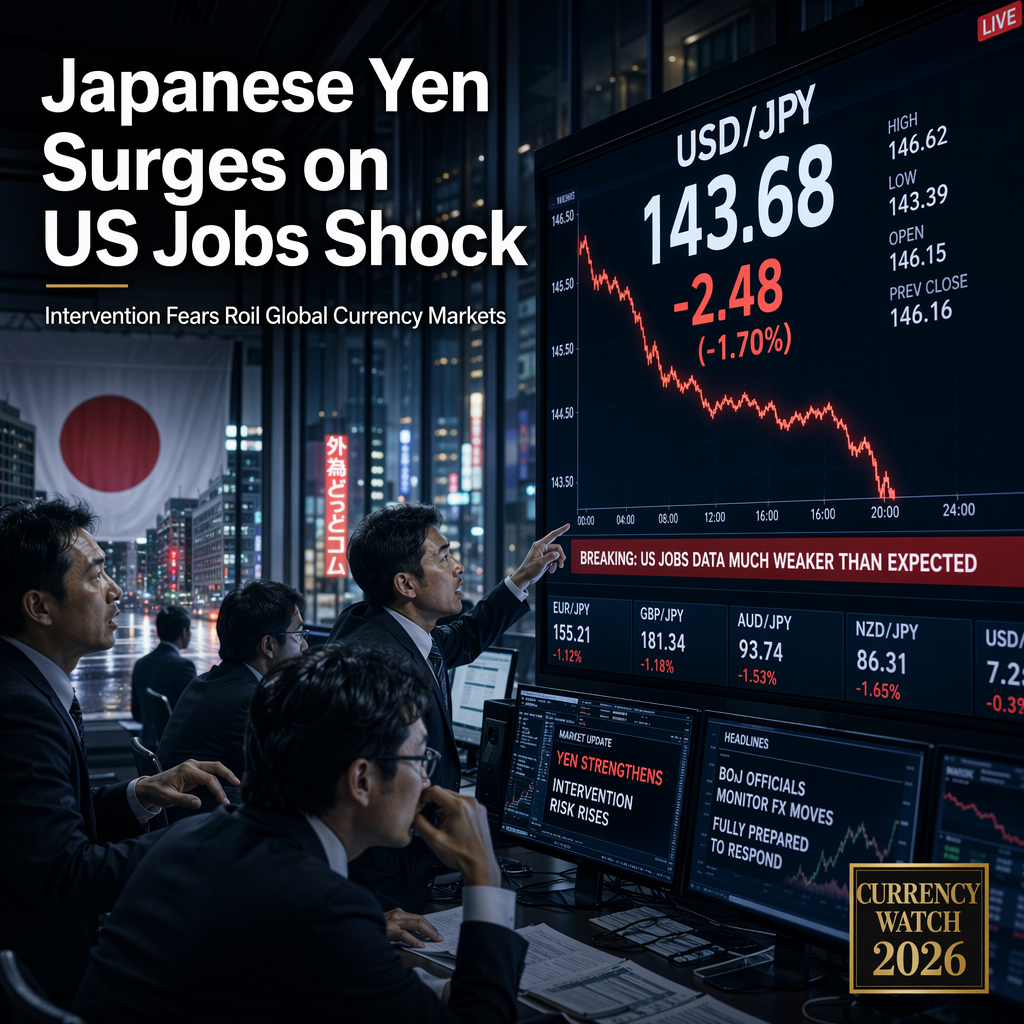
The Japanese Yen (JPY) surged against the US Dollar (USD) on Thursday, briefly strengthening into the 160-per-dollar range for the first time since June 19, 2026, amid mounting fears of possible intervention by Japanese authorities to stabilize the currency following its recent rapid depreciation [1]. The move was further fueled by speculation of coordinated action, with comments from a South Korean currency official adding to the anticipation of intervention [1]. At the time of reporting, USD/JPY traded around 161.05, down 0.92% on the day, making the Yen the strongest major currency against the US Dollar, with a 0.97% gain [2].
The catalyst for the Yen's rebound was a much weaker-than-expected US Nonfarm Payrolls (NFP) report. The US Bureau of Labor Statistics reported that NFP increased by only 57K in June, well below the market expectation of 110K. May's figure was revised down to 129K from 172K, and April's to 148K from 179K, resulting in a combined downward revision of 74K jobs [2][3][4]. Despite the weak headline, the Unemployment Rate unexpectedly declined to 4.2% from 4.3%, and Average Hourly Earnings rose 3.5% year-on-year, in line with expectations [2][3][4]. The Labor Force Participation Rate fell to 61.5% from 61.8% [2][4].
The disappointing US jobs data prompted investors to scale back expectations for further Federal Reserve (Fed) interest rate hikes in 2026. According to the CME FedWatch Tool, the probability of a September rate hike fell to 51% from 63% [3], and the chances for two hikes this year dropped to 27.8% from 31.9% the previous day [4]. The US Dollar Index (DXY) fell to a two-week low of around 100.70 [3]. The Euro (EUR) and Canadian Dollar (CAD) also strengthened against the US Dollar, with EUR/USD hitting a nine-day high at 1.1444, up about 0.60% on the day [3], and USD/CAD falling to 1.4180, its lowest level in more than a week [4].
Market sentiment remains focused on the possibility of Japanese intervention, with Japan's Ministry of Finance declining to comment on the Yen's surge [2]. Technical indicators show the Yen approaching key support levels, with resistance expected around 162 per dollar, a level recently tested as the Yen hit a 39-year low [1]. Financial analysts and traders are closely watching for any official statements or actions from Japanese and regional authorities, as the risk of intervention is considered 'very real' [1][2]. Expectations that the Bank of Japan could raise interest rates again before the end of the year are also underpinning the Yen [2].
While the weak US jobs report has pressured the US Dollar, some analysts caution that the downside may be limited, as the Fed's hawkish stance could persist due to ongoing inflation concerns. San Francisco Fed President Mary Daly stated, 'It's possible we may have to fight more persistent inflation,' suggesting that further rate hikes remain on the table [3].
CONCLUSION
The Japanese Yen's sharp rebound was driven by weak US jobs data and heightened fears of intervention by Japanese authorities. The US Dollar weakened broadly, with major currencies like the Euro and Canadian Dollar also gaining. Market focus remains on potential policy actions from Japan and the Fed, with volatility expected to persist as traders await further signals.