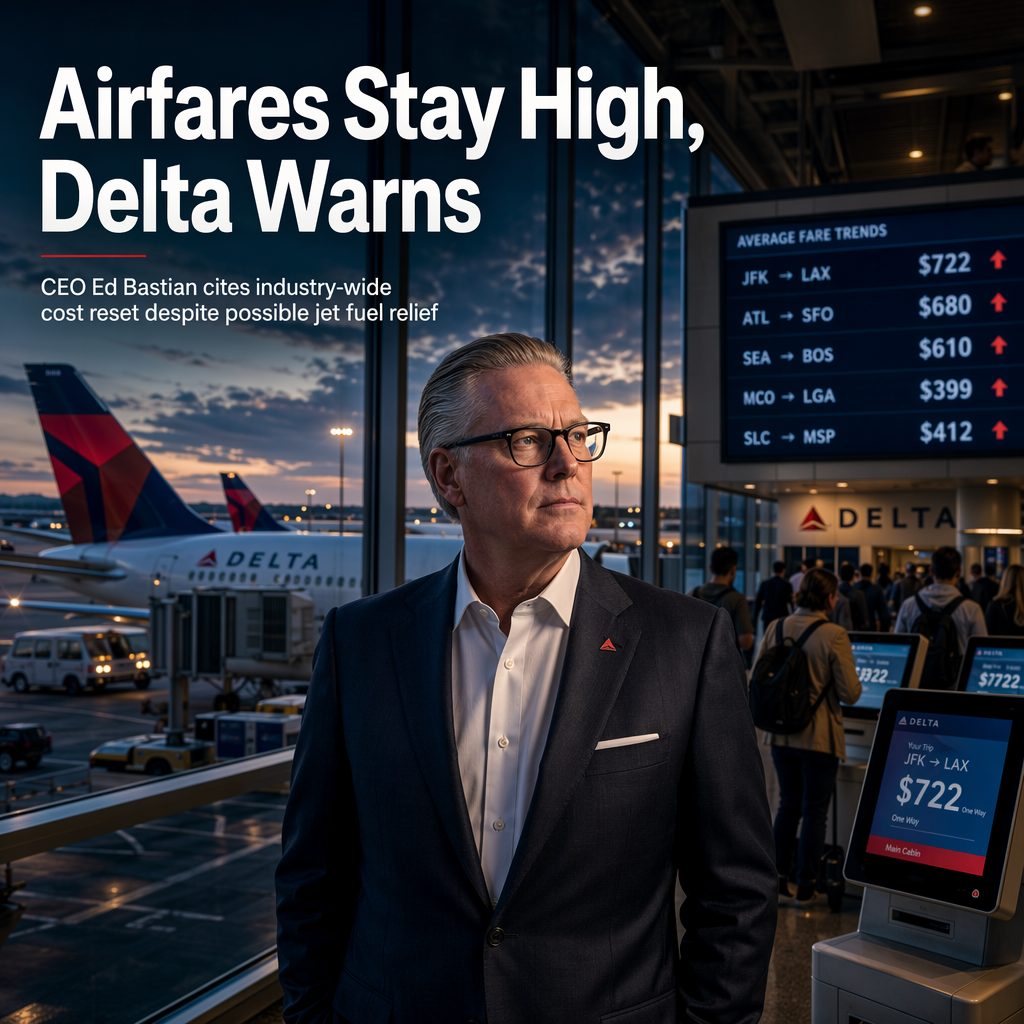
Delta Air Lines CEO Ed Bastian stated during the company's quarterly earnings call that airline fares are expected to remain elevated for consumers, even if jet fuel prices decrease in the future. Bastian attributed this to a significant shift in the airline industry's cost structure, citing not only higher fuel prices but also increased expenses for labor, airport infrastructure, technology, and airplanes. He emphasized that these factors have made it more challenging for low-cost carriers to compete through lower airfares, and that most U.S. carriers are struggling to earn their cost of capital as industry airfares have lagged behind inflation and costs have reset higher [1].
Bastian noted that the industry has managed to recapture this year's fuel cost inflation at the fastest pace of any recent cycle, and he expects these structural changes to continue, supporting steady airfares and revenue outlooks even if energy prices return to pre-Iran war levels. He highlighted that, despite recent fare increases, airfares remain 10 to 15 points below overall inflation since COVID, and much of the industry is still earning returns below the cost of capital [1].
The CEO also pointed out that the low end of the market would need to increase fares by another 5% just to break even at current fuel prices. He argued that the focus should be on securing higher revenues rather than pursuing higher market share, and that Delta has built resilience into its business model through higher airfares and diversified revenue streams, such as its partnership with American Express [1].
Recent data from the Bureau of Labor Statistics showed that airline fares rose 2.7% on a monthly basis in May and were 26.7% higher than a year ago. The BLS is scheduled to release updated CPI inflation data for June next week. Delta Air Lines' stock (DAL) closed at $87.28, down 1.91% [1].
CONCLUSION
Delta Air Lines expects elevated airfares to persist due to higher operational costs, regardless of potential declines in jet fuel prices. The company is focusing on revenue sustainability and business model resilience rather than market share growth. Recent fare increases have not fully offset inflation, and the industry continues to face profitability challenges.