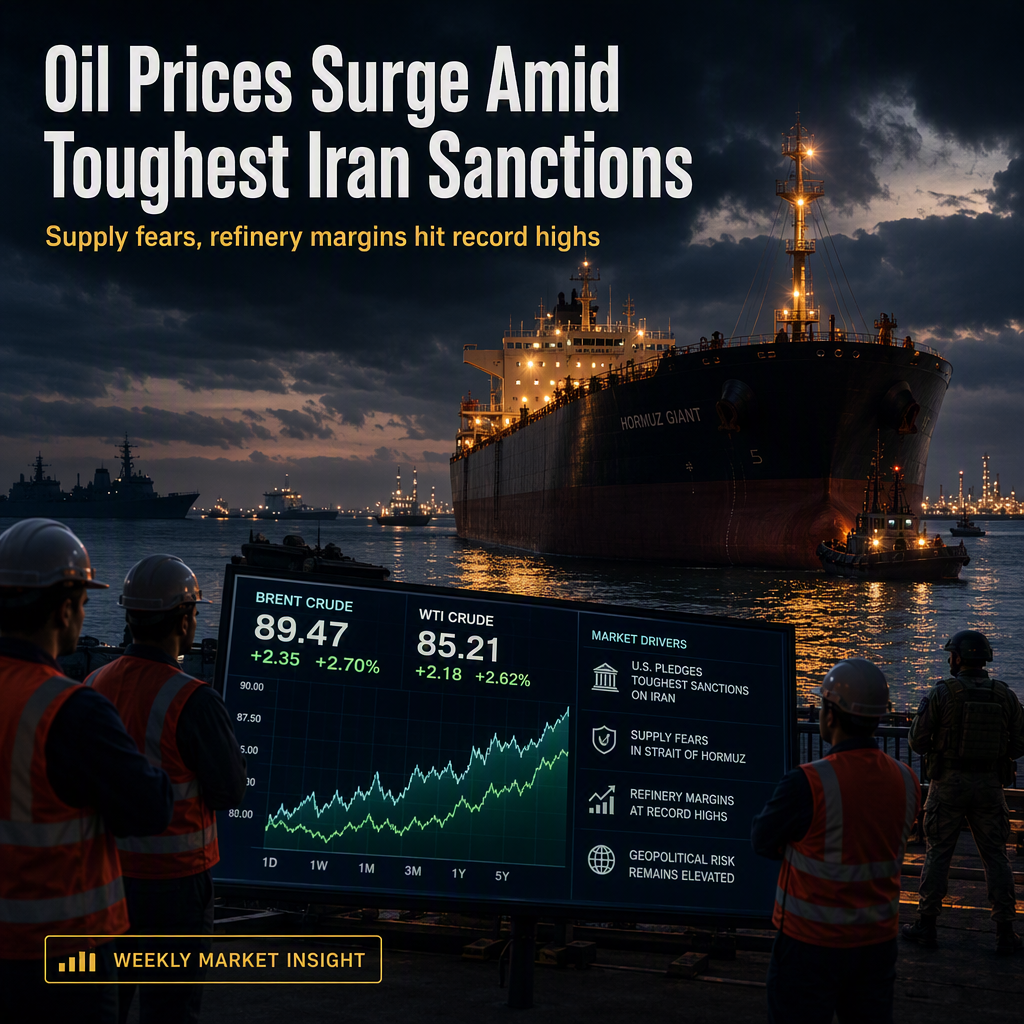
Oil prices eased slightly on Friday but remained on track for a second consecutive weekly gain, driven by the U.S. government's commitment to impose the 'toughest sanctions in history' against Iran [1]. U.S. Treasury Secretary Scott Bessent stated that these measures would focus on maximum economic pressure rather than a return to large-scale military combat, which he described as 'unlikely' [1]. Despite this, markets are now 'pricing in the failure of diplomacy,' according to Janiv Shah, vice president of oil markets analysis at Rystad Energy [1].
Brent crude futures were reported to be 0.8% lower at 4:50 ET on Friday, while U.S. West Texas Intermediate futures for October delivery were down 0.89% [1]. Nevertheless, Brent crude is on course for a monthly gain of nearly 6%, following a 5.95% rise the previous week, and closed above $93 a barrel on Thursday for the first time since July 24 [1]. The recent hardening of Washington's stance has increased uncertainty over the future of shipping through the Strait of Hormuz, with vessel traffic remaining slow amid fatal attacks [1].
Analysts highlighted that the most significant pressure is being felt in refined product markets, with diesel cracks hitting record highs due to fears of prompt supply shortages, sustained demand, and thin inventory buffers [1]. Shah noted that while Brent prices could fluctuate widely depending on future scenarios, product markets are expected to experience a more substantial impact, with refinery constraints and energy security concerns keeping product cracks and margins elevated [1].
Earlier in August, crude oil prices had eased significantly as U.S. officials suggested a potential deal with Tehran, but the shift to a tougher U.S. position has reversed this trend and heightened market uncertainty [1].
CONCLUSION
Oil prices are set for a second weekly gain as the U.S. intensifies economic pressure on Iran, raising concerns over supply disruptions and energy security. While crude prices have fluctuated, refined product markets are experiencing the greatest impact, with record-high diesel cracks and elevated margins. The market is now focused on the potential for further supply constraints amid ongoing geopolitical tensions.