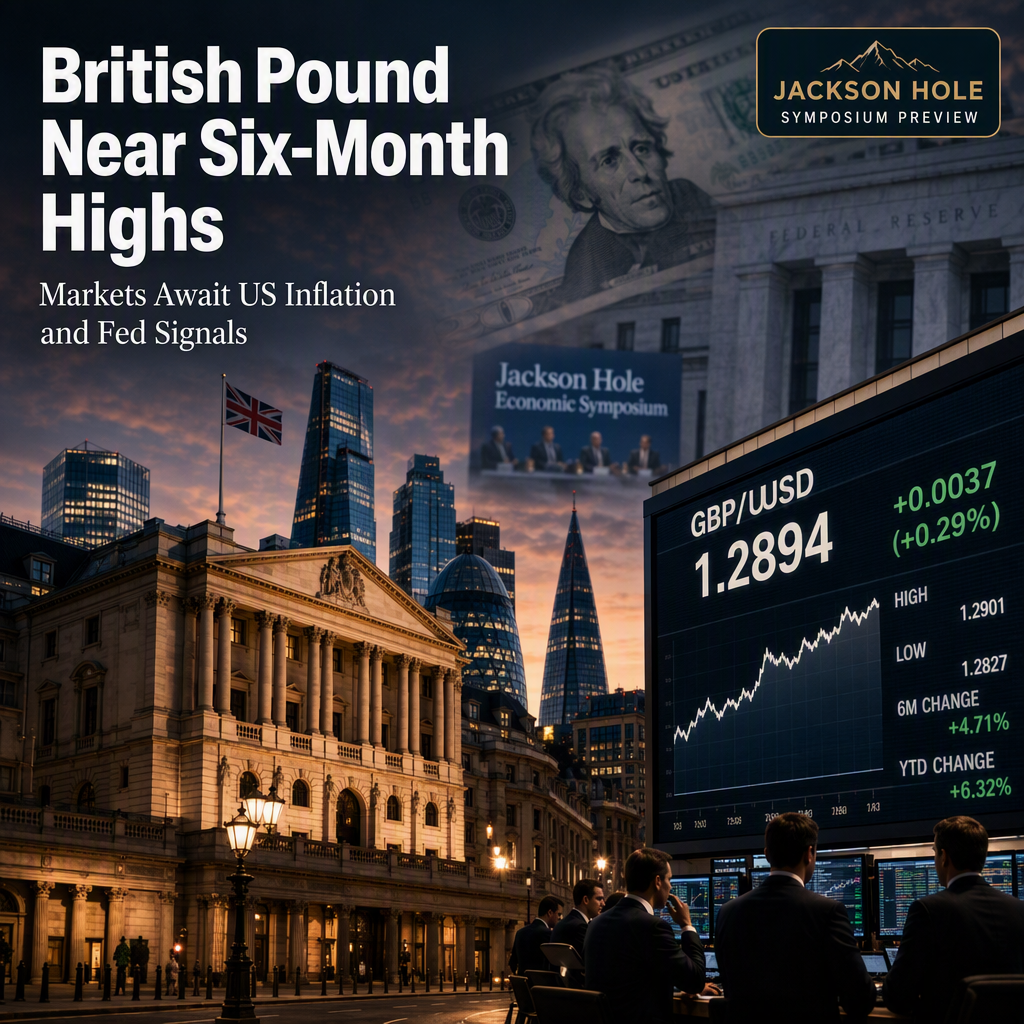
The British Pound (GBP) is trading near six-month highs against the US Dollar (USD), with the GBP/USD pair flatlining around 1.3630 after reaching a recent peak of 1.3675 last week [1]. Market participants are adopting a 'wait-and-see' approach ahead of significant US events, including the release of August’s US Personal Consumption Expenditures (PCE) Price Index on Wednesday and the Jackson Hole central bankers’ summit on Friday [1]. FX volatility remains unusually low in the absence of major macroeconomic releases, with consensus expectations pointing to persistent inflationary pressures in the US, which could prompt further calls for monetary tightening by Federal Reserve hawks [1].
A notable development is that USD positioning has shifted from long to short, with analysts at TD Securities suggesting there is further room for this trend to grow. They note that the broad USD downtrend remains intact, except in select pairs such as USDCAD [1]. The highlight of the week is anticipated to be the Jackson Hole Symposium, particularly the speech by Fed Chairman Kevin Warsh, as investors look for insights into the Federal Reserve’s near-term monetary policy direction amid renewed doubts about the central bank's independence [1].
Looking forward, strategists at UOB Group see potential for further GBP appreciation over the next one to three weeks. The bank turned positive on GBP on August 17 (spot at 1.3540) and assesses that GBP/USD could continue to rise to 1.3700, unless GBP breaks below 1.3585 [1].
No immediate market reactions or significant volatility have been observed, as traders await the outcome of the upcoming US economic data and central bank commentary [1].
CONCLUSION
The British Pound remains stable near recent highs as markets await key US inflation data and the Jackson Hole Symposium for further direction. Analyst sentiment is cautiously optimistic for GBP, with potential for further gains if current support levels hold. Market participants are closely monitoring upcoming events for signals on future monetary policy.