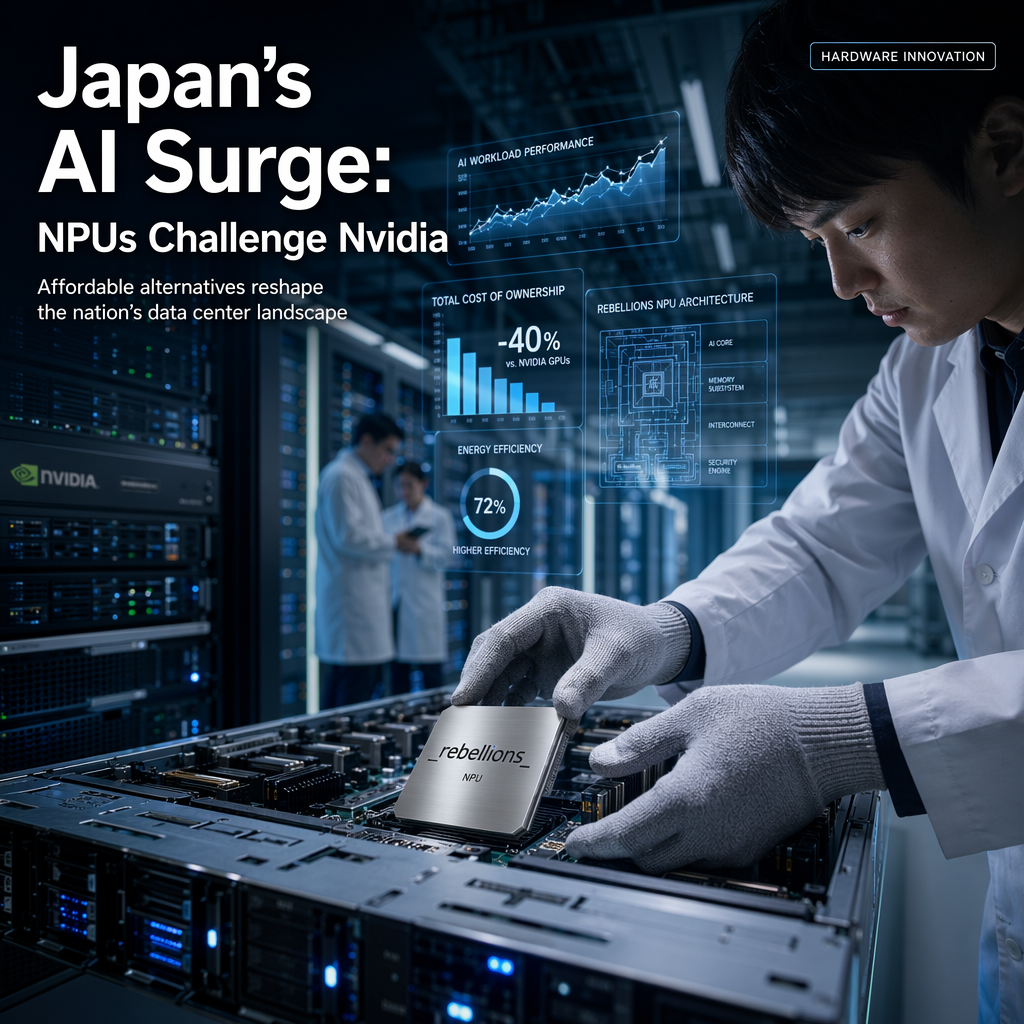
Japanese AI-related companies are increasingly seeking alternatives to Nvidia's graphics processing units (GPUs) due to their high costs, which have become a significant barrier for both startups and established firms in the market [1]. In response, efforts are underway to introduce more affordable server options, with neural processing units (NPUs) and cache servers emerging as cost-effective solutions for AI data center infrastructure [1].
The article highlights the deployment of Rebellions' NPU semiconductors in AI data center servers across Japan, aiming to address the financial challenges associated with Nvidia-powered systems [1]. Industry experts note that these alternative server configurations can deliver comparable performance to traditional GPU setups but at a fraction of the cost, making them particularly attractive as AI adoption expands across various sectors [1].
This trend is expected to continue, with market analysts forecasting that the rise of NPU and cache server options could reshape the competitive landscape and challenge Nvidia's dominance in the AI hardware sector [1]. As AI-driven applications proliferate, the focus on affordable and scalable computing solutions is likely to influence purchasing decisions and capital expenditure strategies throughout Japan's technology ecosystem [1].
While the article does not provide explicit financial data or trading advice, the overall market sentiment suggests a positive outlook for alternative semiconductor architectures, presenting new opportunities for both hardware providers and AI industry consumers [1].
CONCLUSION
Japanese AI companies are actively adopting NPU and cache server technologies to mitigate the high costs of Nvidia GPUs, signaling a potential shift in the AI hardware market. This movement could challenge Nvidia's market position and foster greater accessibility and innovation within Japan's AI and data center sectors.