
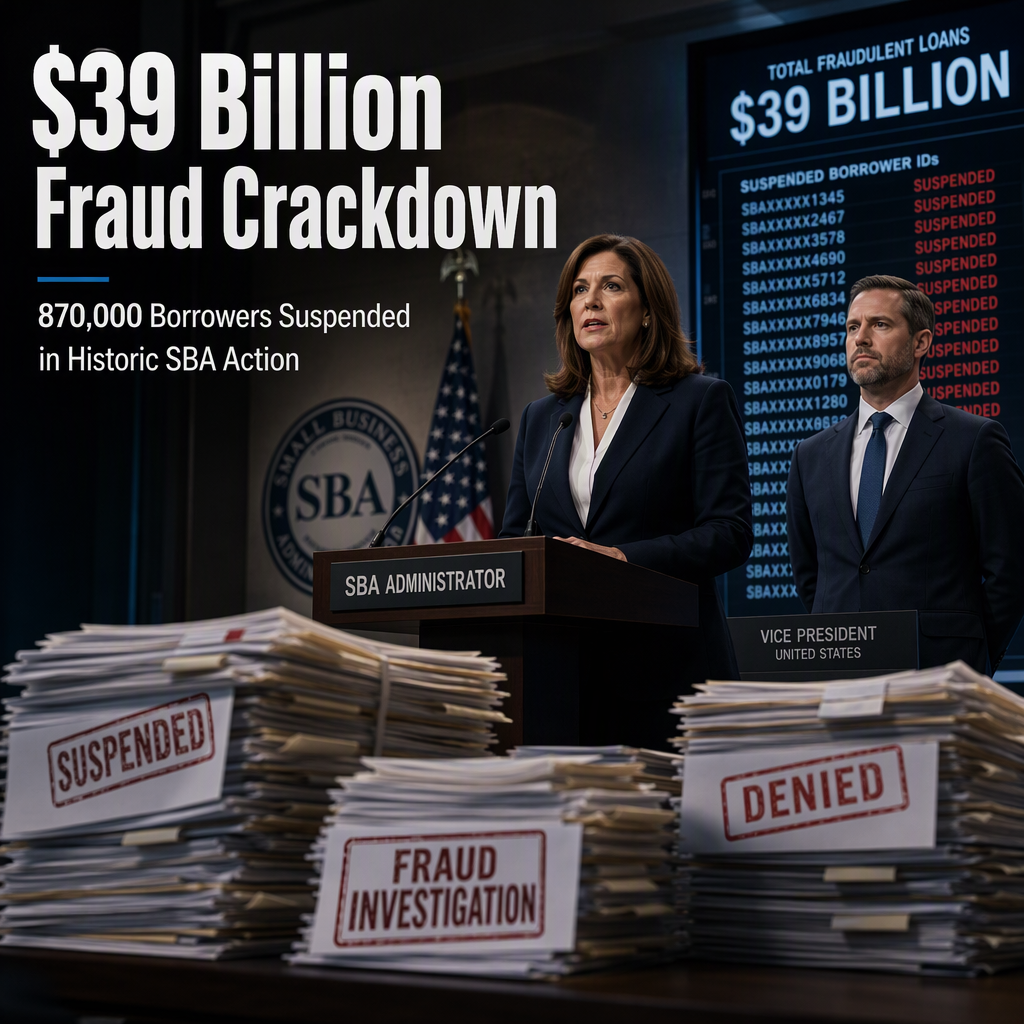
The Small Business Administration (SBA) has taken unprecedented action against pandemic-related fraud, announcing the suspension of 870,000 borrowers linked to an estimated $39 billion in suspected fraudulent activity. This announcement was made last month in Kansas City, Missouri, by SBA Administrator Kelly Loeffler alongside Vice President JD Vance, marking the largest anti-fraud action in the agency's history [1]. The SBA's efforts are part of a broader initiative led by the Trump administration's Task Force to Eliminate Fraud, which aims to address waste, fraud, and abuse at historic rates [1].
The scale of pandemic loan fraud has been a contentious issue. In 2023, the SBA’s Office of Inspector General estimated that more than $200 billion in pandemic loans may have been lost to fraudsters, while agency leadership at the time claimed the actual figure was closer to $36 billion. This $164 billion discrepancy remains unresolved, as then-SBA Administrator Isabella Guzman declined to testify before the House Committee on Small Business, which has spent 18 months investigating the matter [1].
In addition to pandemic loan fraud, the SBA has targeted abuse in the 8(a) program, which is designed to help disadvantaged small businesses compete for federal contracts. Administrator Loeffler initiated a comprehensive audit of the program—the first in nearly 50 years—and moved to expel hundreds of firms that refused to provide financial records. The SBA has also closed loopholes that previously allowed loans to be issued in the names of children and deceased individuals, some listed as being older than 115 years [1].
The article highlights criticism of the Biden-Harris administration for failing to act on known fraud and notes that House Republicans have played a leading role in the recovery efforts. The SBA's recent actions are positioned as a significant step toward restoring integrity to federal small business support programs [1].
CONCLUSION
The SBA's suspension of 870,000 borrowers and crackdown on $39 billion in suspected pandemic fraud represents a major escalation in efforts to recover misused federal funds. The agency's actions, including audits and closing of loopholes, signal a renewed focus on accountability and oversight in small business programs. Market participants should note the heightened scrutiny and potential for further enforcement actions in the sector.