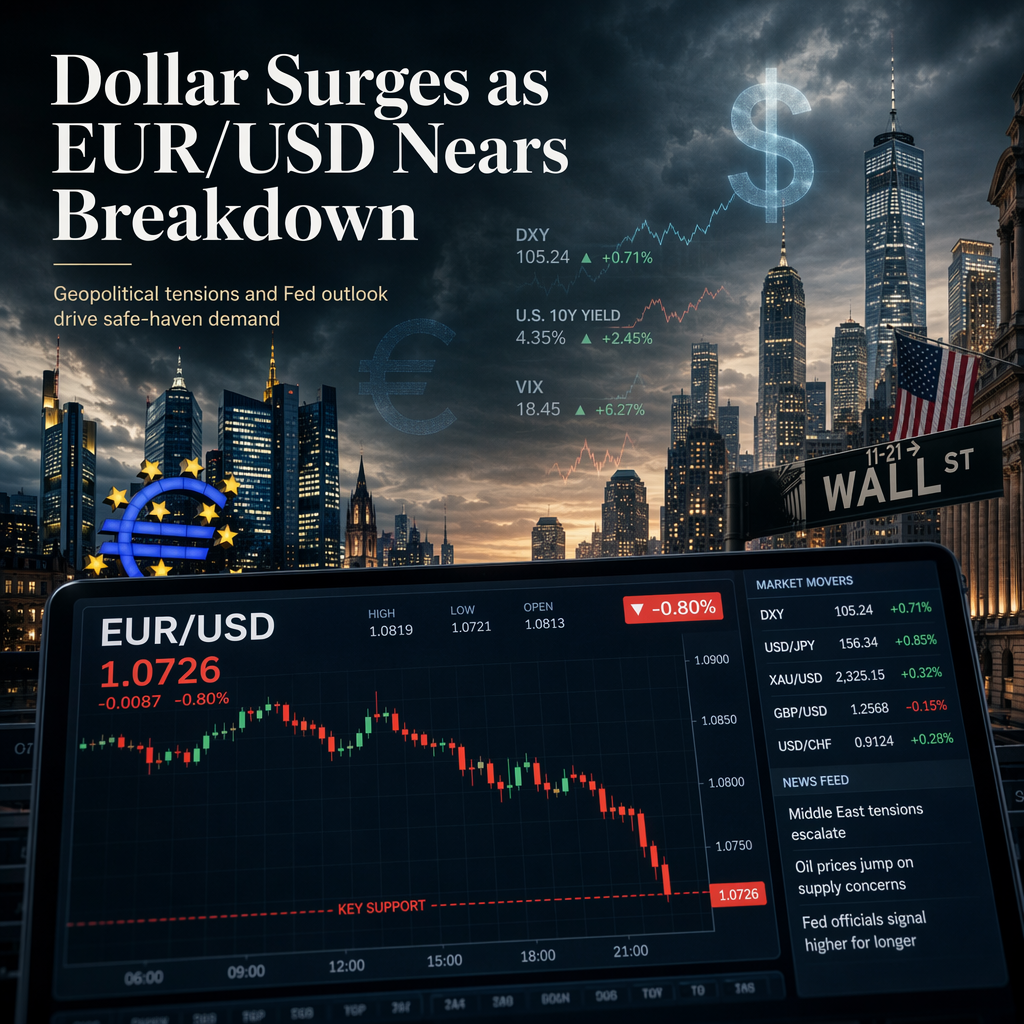
The EUR/USD currency pair traded on the back foot Thursday, pressured by rising geopolitical tensions in the Middle East that have pushed oil prices higher and fueled expectations for a more hawkish Federal Reserve stance, thereby increasing demand for the US Dollar (USD) [1]. At the time of reporting, EUR/USD was trading around 1.1379, near three-week lows, while the US Dollar Index (DXY) stood at approximately 101.40, recovering from an intraday low of 100.94 [1].
The European Central Bank (ECB) decided to leave interest rates unchanged, but this move elicited little reaction from the market [1]. Technically, EUR/USD has established a base above the 1.1350 support level, though downside risks are mounting. The pair remains below key moving averages: the 21-day SMA at 1.1415, the 50-day SMA at 1.1504, and the 100-day SMA at 1.1576, reinforcing a bearish near-term and broader structure [1]. The Relative Strength Index (RSI) is at 39, below the neutral 50 mark, indicating persistent bearish momentum, while the MACD is marginally positive, suggesting tentative buying interest [1].
Immediate resistance is identified at the 21-day SMA near 1.1415, followed by the 50-day SMA at 1.1504 and the 100-day SMA at 1.1576, with a key horizontal resistance at 1.1700 [1]. On the downside, a sustained break below the 1.1350 support could lead to deeper losses, whereas holding above this level may open the door for a corrective rebound toward the moving averages [1].
In terms of broader currency market movements, the US Dollar was the strongest against the New Zealand Dollar, gaining 0.68% on the day [1]. The USD also posted gains against the EUR (0.29%), GBP (0.39%), CAD (0.30%), AUD (0.68%), and CHF (0.24%), while it slipped slightly against the JPY (-0.08%) [1].
CONCLUSION
EUR/USD remains under pressure amid heightened geopolitical risks and expectations of a hawkish Fed, with technical indicators pointing to persistent bearish momentum. A break below the 1.1350 support could trigger further declines, while stabilization above this level may allow for a corrective rebound. The US Dollar's broad strength, especially against the New Zealand Dollar, underscores its safe-haven appeal in the current environment.