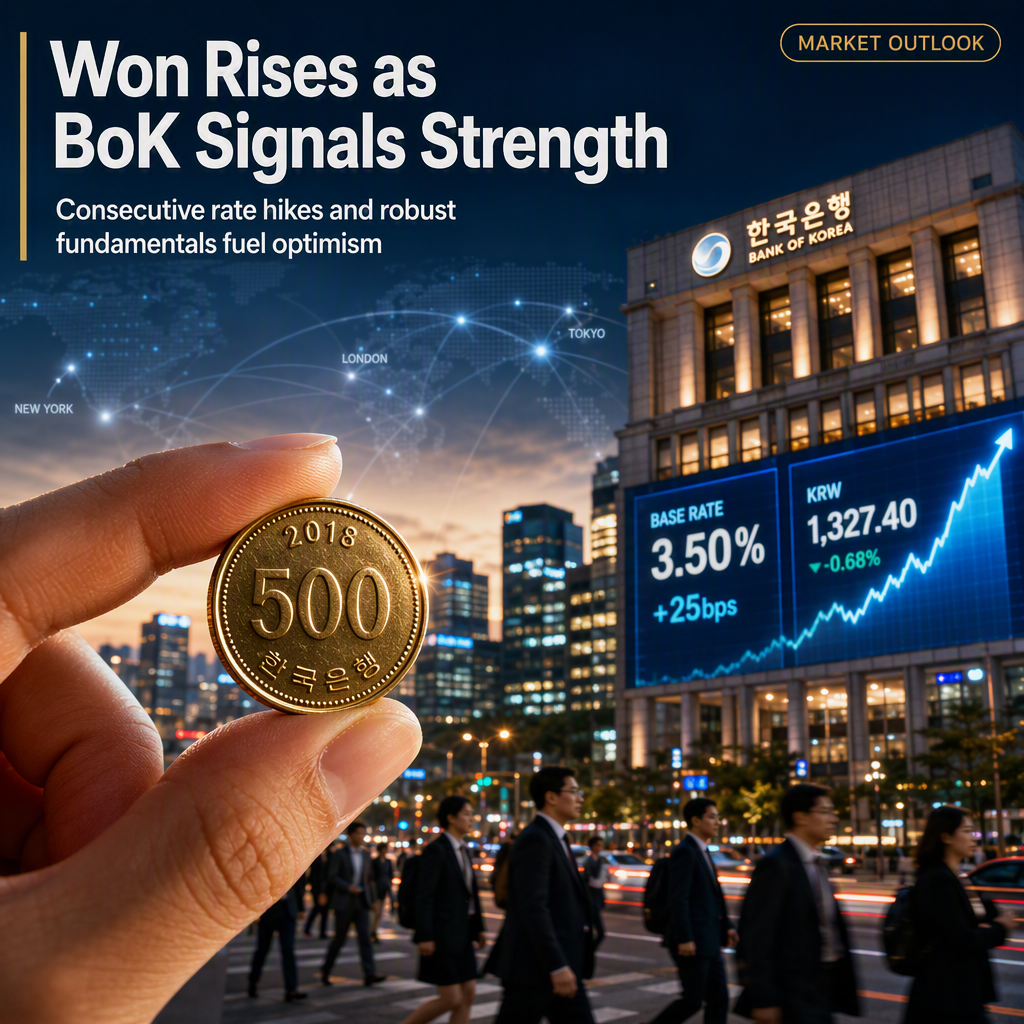
The South Korean Won (KRW) is trading near a one-year low against the US dollar following the Bank of Korea's (BoK) decision to implement a back-to-back 25 basis point interest rate hike, bringing the base rate to 3.00% [1]. This move was anticipated by most analysts, with 14 out of 22 polled by Bloomberg expecting a hike, while the remainder predicted a hold [1]. The BoK's forward guidance was more cautious compared to previous statements, as it removed language suggesting a continued need for further rate hikes and instead stated it 'will determine the timing and pace of further Base Rate hikes based on incoming data' [1].
The BoK's six-month ahead conditional policy rate projection indicates a range of expectations among its members: six members foresee a rate of 3.50%, ten expect 3.25%, and five anticipate 3.00% [1]. Market pricing via the swaps curve suggests a policy rate closer to 3.50% within the next six months and potentially 3.75% in the next twelve months [1].
Fundamentally, the KRW is described as significantly undervalued, supported by South Korea's large current account surplus, which stood at 9.4% of GDP in Q1 [1]. Additionally, the expected full inclusion of South Korea in the World Government Bond Index (WGBI) by November is projected to sustain foreign bond inflows, further supporting the currency [1]. Brown Brothers Harriman’s Elias Haddad argues that these factors, combined with the BoK's scope for additional rate hikes, underpin a positive outlook for the KRW [1].
CONCLUSION
The Bank of Korea's consecutive rate hikes and positive macroeconomic fundamentals, including a substantial current account surplus and anticipated foreign bond inflows, are supporting the South Korean Won. While the BoK has adopted a more data-dependent stance, market expectations remain for further tightening, suggesting continued strength for the KRW in the near term.