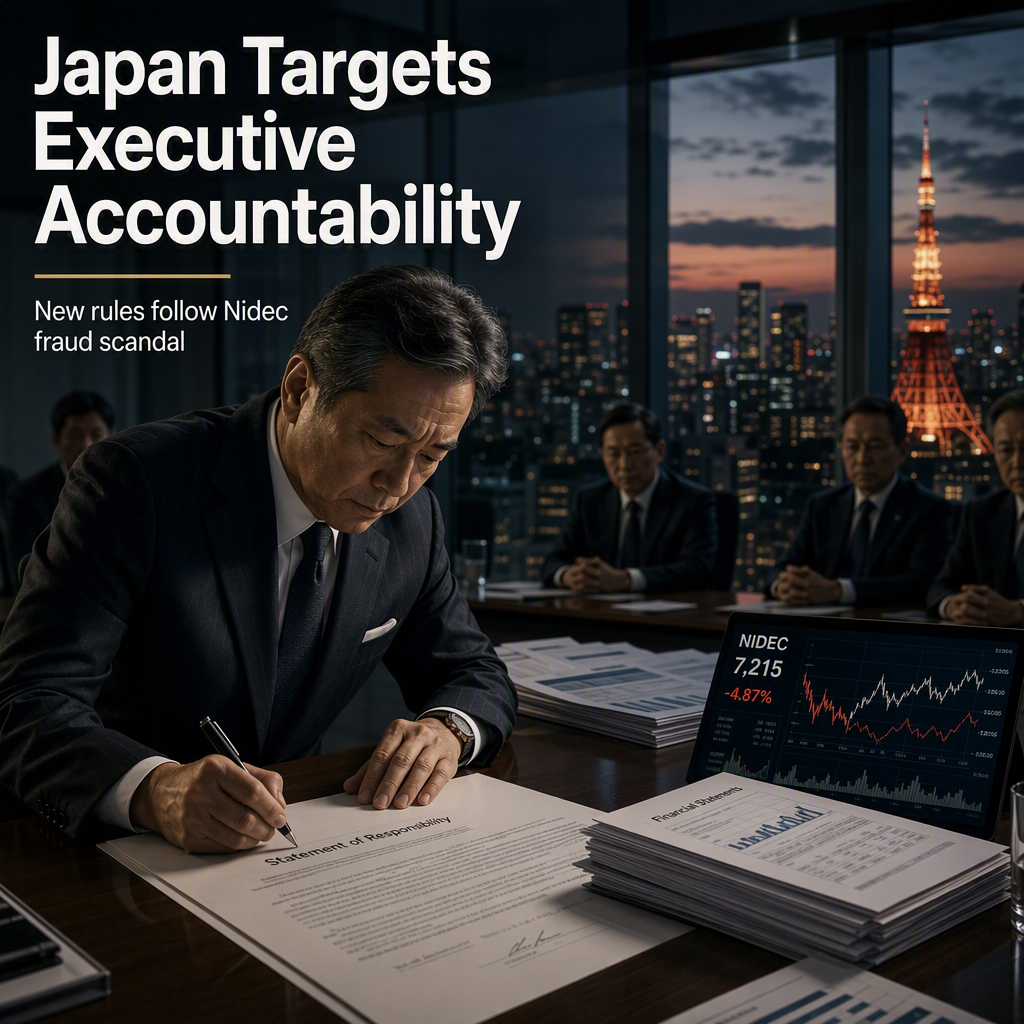
Japan's Financial Services Agency (FSA) will introduce new regulations requiring top executives at listed companies to personally declare that they have ensured the proper preparation of securities reports, in an effort to clarify responsibility and prevent accounting fraud [1]. This regulatory change is a direct response to a series of recent accounting fraud cases involving Japanese companies, notably Nidec and KDDI [1].
Under the new requirements, executives must explicitly state in securities filings that they have taken steps to confirm the accuracy and integrity of their company's financial statements [1]. The FSA expects this measure to increase executive awareness and diligence, thereby reducing the risk of fraud and financial misstatements [1].
The move follows criticism of Japan's current approach to accounting fraud, with market observers and experts highlighting that relatively low fines have contributed to ongoing issues [1]. The Nidec case, in particular, has drawn attention after the company faced allegations of accounting fraud and could be subject to a $1.6 billion impairment review [1].
By placing direct accountability on senior management, the FSA aims to strengthen the reliability of Japanese capital markets and restore investor confidence, ensuring that top executives cannot evade responsibility for fraudulent or misleading financial reporting [1].
CONCLUSION
Japan's Financial Services Agency is taking decisive action to address accounting fraud by holding top executives directly accountable for the accuracy of financial disclosures. This reform is expected to enhance market integrity and investor trust, particularly in the wake of high-profile scandals such as Nidec's.