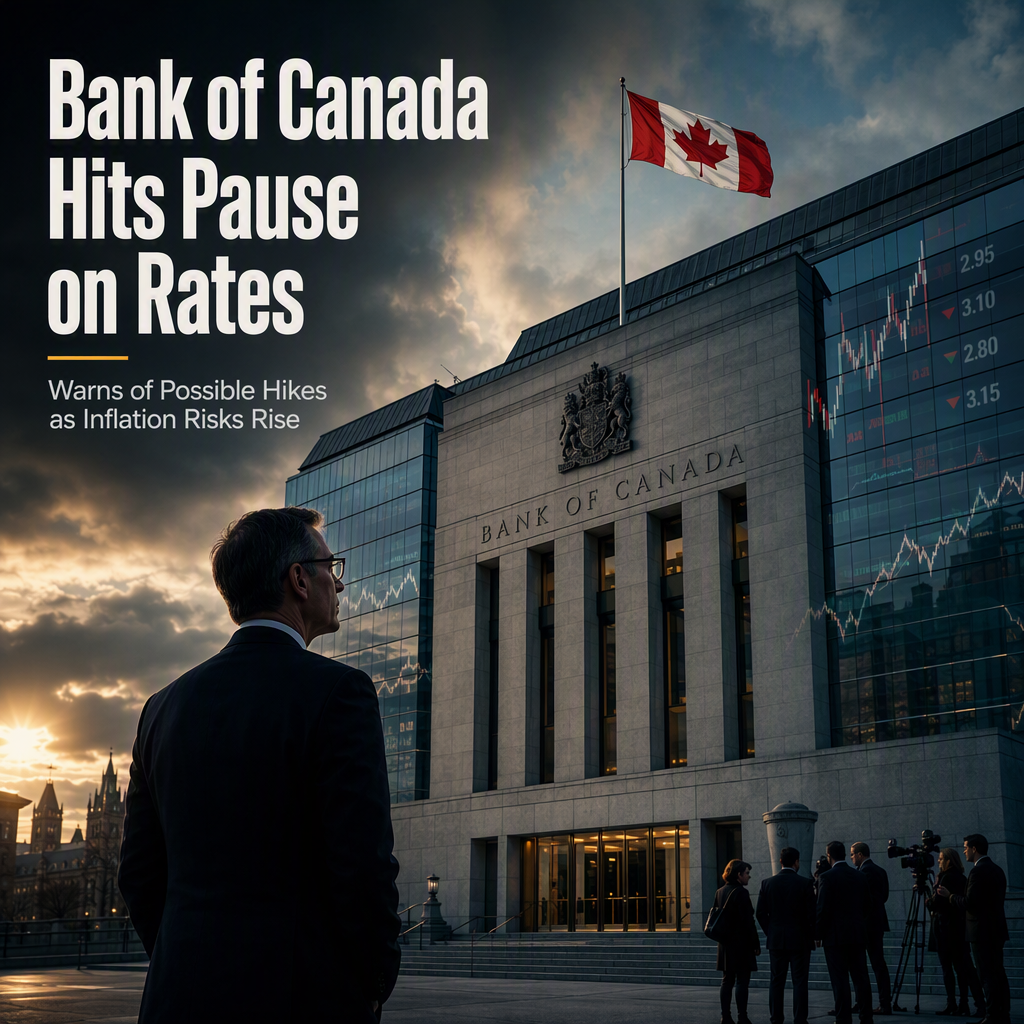
The Bank of Canada (BoC) maintained its overnight interest rate at 2.25%, a move that was widely anticipated by the market. However, the central bank adopted a more cautious tone in its messaging, citing increased inflation risks and growing uncertainty about the sustainability of the economic recovery [1]. Governor Tiff Macklem stated that multiple rate increases could be required if inflation persists, emphasizing that future policy decisions will be guided by the inflation outlook and associated risks [1].
The BoC's statement pointed to a challenging environment characterized by subdued labour demand, continued excess supply, and heightened uncertainty due to new US tariffs and the threat of further trade actions. Additionally, the ongoing Middle East conflict is contributing to elevated energy prices, particularly in gasoline and oil, which are the main drivers of the current inflation uptick [1].
Macklem acknowledged that inflation remains too high, but clarified that the increase is largely concentrated in energy prices. He stressed that the central bank's tolerance for higher inflation is limited and that it stands ready to adjust monetary policy as risks evolve. While the possibility of multiple rate hikes was raised, Macklem did not present this as the central scenario, instead reiterating that decisions will depend on future inflation data and risk assessments [1].
The recent sell-off in the bond market was also addressed, with Macklem noting that rising global bond yields are affecting Canada. Deputy Governor Rogers described the move as a repricing of risk rather than a sign of financial instability, suggesting the BoC does not view the bond-market volatility as an immediate policy concern [1]. Overall, the BoC's decision reflects a cautiously hawkish stance: rates remain on hold due to economic slack and trade uncertainty, but the warning of potential hikes signals that a renewed tightening cycle is possible if inflation pressures broaden beyond energy [1].
CONCLUSION
The Bank of Canada opted for a cautious hold on interest rates, balancing concerns over persistent inflation—mainly from energy prices—and ongoing economic uncertainty. While no immediate policy shift was enacted, the central bank signaled that further rate hikes remain a possibility if inflation risks intensify, keeping markets alert to future developments.