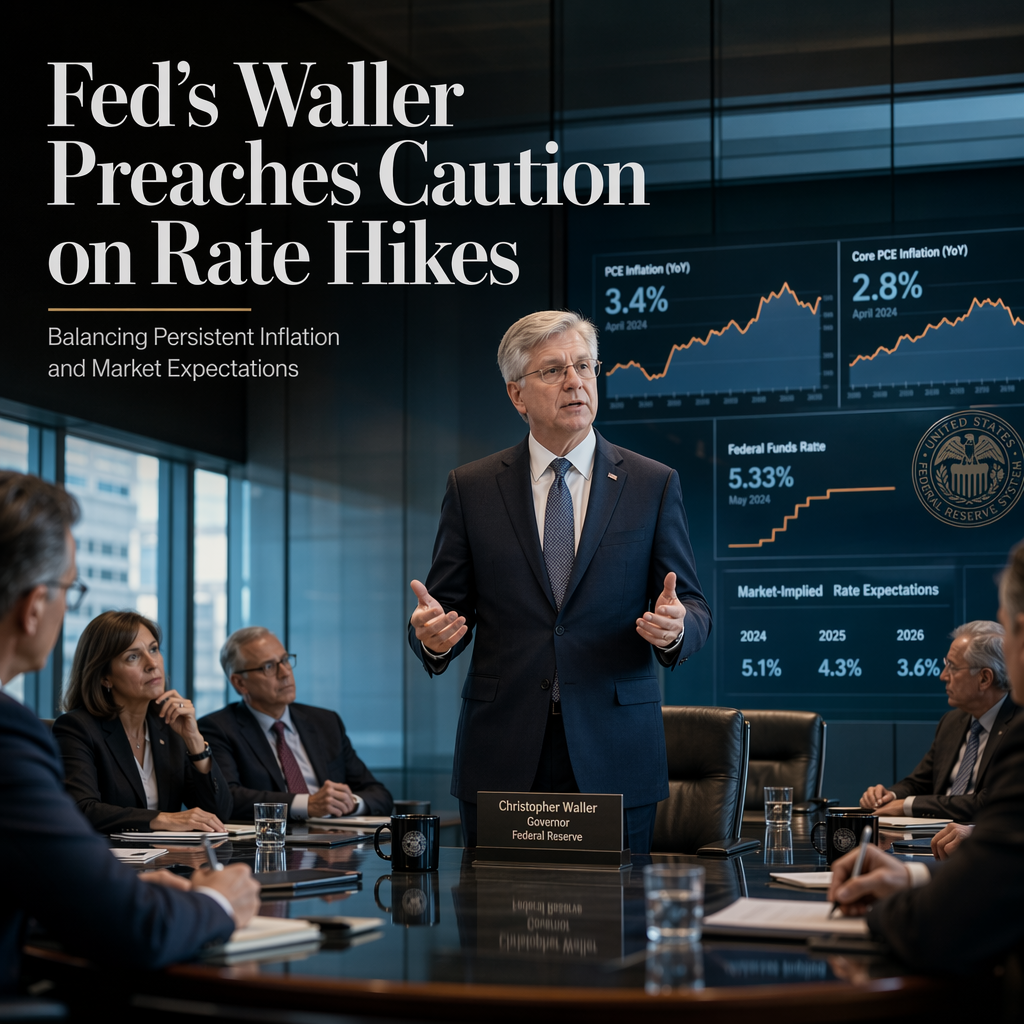
Federal Reserve Governor Christopher Waller, in a speech delivered in New York on July 13, 2026, addressed ongoing concerns about inflation and the central bank's approach to interest rate policy. Waller emphasized the importance of not 'fighting the last war' on inflation, cautioning against a reflexive move to raise interest rates without sufficient data to justify such action [1]. He acknowledged past mistakes, specifically referencing the Fed's delayed response to high inflation in 2021, and expressed determination to avoid repeating those errors [1].
Waller identified several factors contributing to persistent inflation, including tariffs implemented in 2025, rising energy prices linked to conflict in the Middle East, and increased demand driven by artificial intelligence. He noted that inflation has expanded beyond traditional drivers, and warned that while there is a 'credible case for inflation to begin to fall back,' there is also an 'equally plausible' risk that inflation could remain elevated or rise further, potentially necessitating tighter monetary policy in the near term [1].
The policymaker highlighted two positive factors: a strong labor market that is not a significant source of inflation and well-anchored inflation expectations, at least according to market-based measures. However, he cautioned against complacency, stating that central bankers cannot simply rely on anchored expectations and must be prepared to act if inflation remains above target [1].
Waller's remarks were made ahead of the Bureau of Labor Statistics' release of the June consumer price index (CPI) data. Economists surveyed by Dow Jones anticipate a 0.2% monthly decline in the headline CPI, driven by a sharp drop in oil prices, and a 0.2% core increase excluding food and energy. On an annual basis, these projections would bring the headline CPI down to 3.8% from 4.2% in May, and core CPI to 2.8% from 2.9% [1]. Waller stated he would be 'very pleased to see a lower reading on core inflation,' but emphasized the need for several months of lower readings before feeling confident that inflation is under control [1].
CONCLUSION
Governor Waller's comments reflect a cautious and data-driven approach to monetary policy, balancing the risks of acting too soon against the dangers of waiting too long. The market is likely to interpret his remarks as signaling no immediate rate hikes, but with the possibility of tightening if inflation remains persistent.