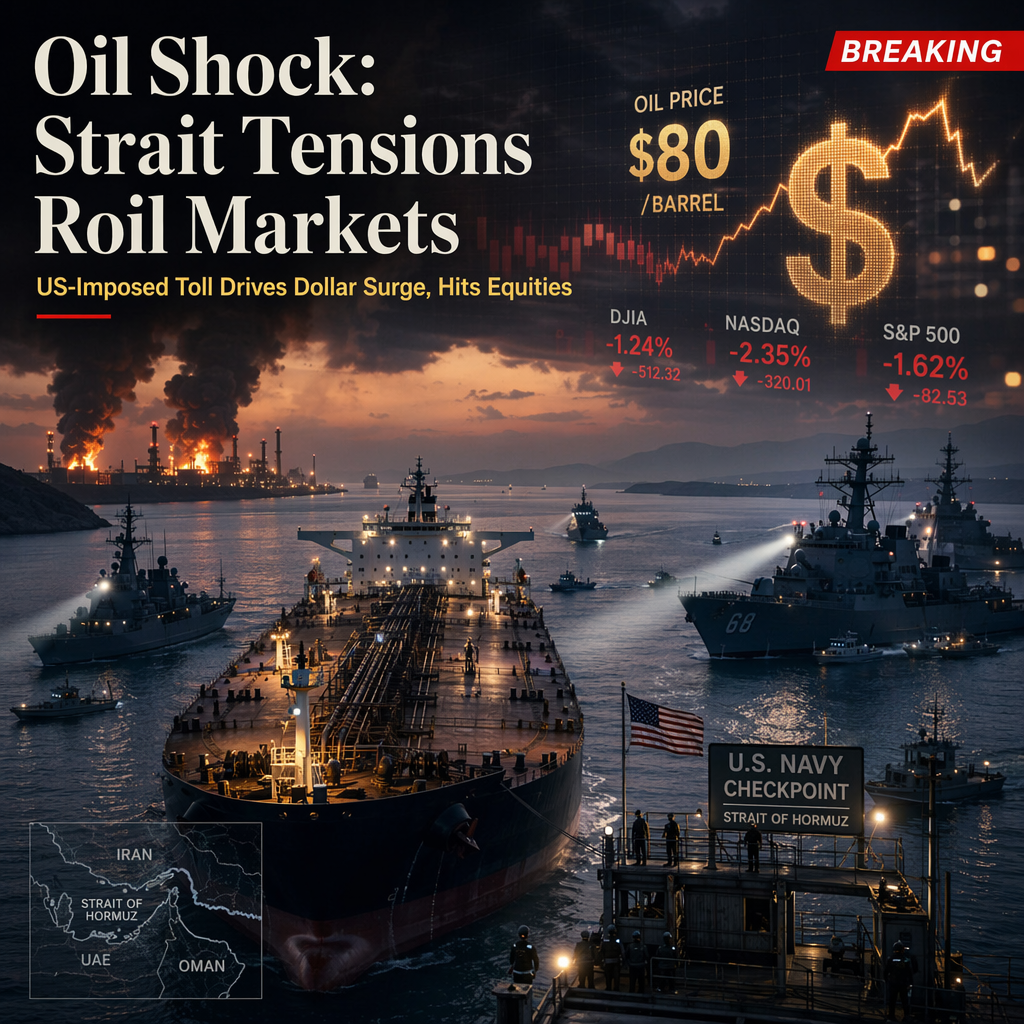
Over the weekend, escalating tensions in the Middle East triggered significant market movements, with both the currency and equity markets reacting to geopolitical developments. The British Pound Sterling began the week on a weaker note, with GBP/USD trading at 1.3369, down over 0.20% as of the report, as investors sought safe-haven assets amid rising oil prices and renewed inflationary pressures [1]. The US Dollar Index (DXY) rose 0.18% to 101.14, reflecting increased demand for the Greenback [1]. US Treasury yields also climbed, with traders fully pricing in a 33-basis-point increase in US interest rates by year-end, driven by expectations of higher energy costs [1].
The immediate catalyst was a series of attacks between the US and Iran, culminating in Tehran's assault on a commercial vessel in the Strait of Hormuz, followed by US strikes on Iranian targets and subsequent Iranian retaliation against US facilities in the Gulf [2]. Iran declared the waterway closed to traffic, a claim disputed by Trump, who insisted the shipping lane remains open [2]. On Monday, Trump announced the reinstatement of what he termed the 'Iranian blockade,' stating that the US would collect a 20% reimbursement on all cargo allowed through the Strait, targeting only Iranian ships and their customers [2]. This move comes despite a recent ceasefire framework that barred Tehran from charging commercial ships for passage [2].
The oil market responded swiftly, with West Texas Intermediate (WTI) futures jumping over 5% to trade above $75 per barrel and Brent futures rising 5.3% toward $80 per barrel [2]. Equity markets interpreted the supply chokepoint and new toll regime as an inflationary threat, particularly as investors had been looking for signs of disinflation [2]. The Dow Jones Industrial Average (DJIA) showed relative resilience, trading near 52,525, down 117 points or 0.2%, while the Nasdaq Composite fell 1% and the S&P 500 dropped 0.4% [2]. The Dow's smaller loss was attributed to its sector composition, which is less exposed to the semiconductor sector that saw concentrated selling [2].
Semiconductor stocks were particularly hard hit, with SK Hynix (SKHY) falling 7% in its second US session after a 13% debut pop on Friday, and Micron (MU) down 6% [2]. The market's reaction underscores the sensitivity of risk assets to geopolitical shocks and the potential for higher energy and goods costs to disrupt the disinflation narrative [2].
Looking ahead, traders are awaiting the US Consumer Price Index (CPI) data for June, scheduled for release on July 14. Economists estimate headline CPI will dip -0.1% month-over-month, down from a 0.5% increase, while core CPI is projected to remain unchanged at 0.2% month-over-month [1]. In the UK, uncertainty surrounding the incoming Prime Minister Andy Burnham's cabinet and adherence to fiscal rules could pose additional headwinds for Sterling, with money markets pricing in 33 basis points of Bank of England tightening by the end of 2026 [1].
CONCLUSION
Escalating Middle East tensions and the US-imposed toll on the Strait of Hormuz have driven oil prices sharply higher, strengthened the US Dollar, and triggered risk aversion across global markets. Equity indices, particularly those exposed to technology and semiconductors, suffered notable losses, while the British Pound weakened amid inflation concerns and UK political uncertainty. The market remains focused on upcoming US inflation data and ongoing geopolitical developments for further direction.