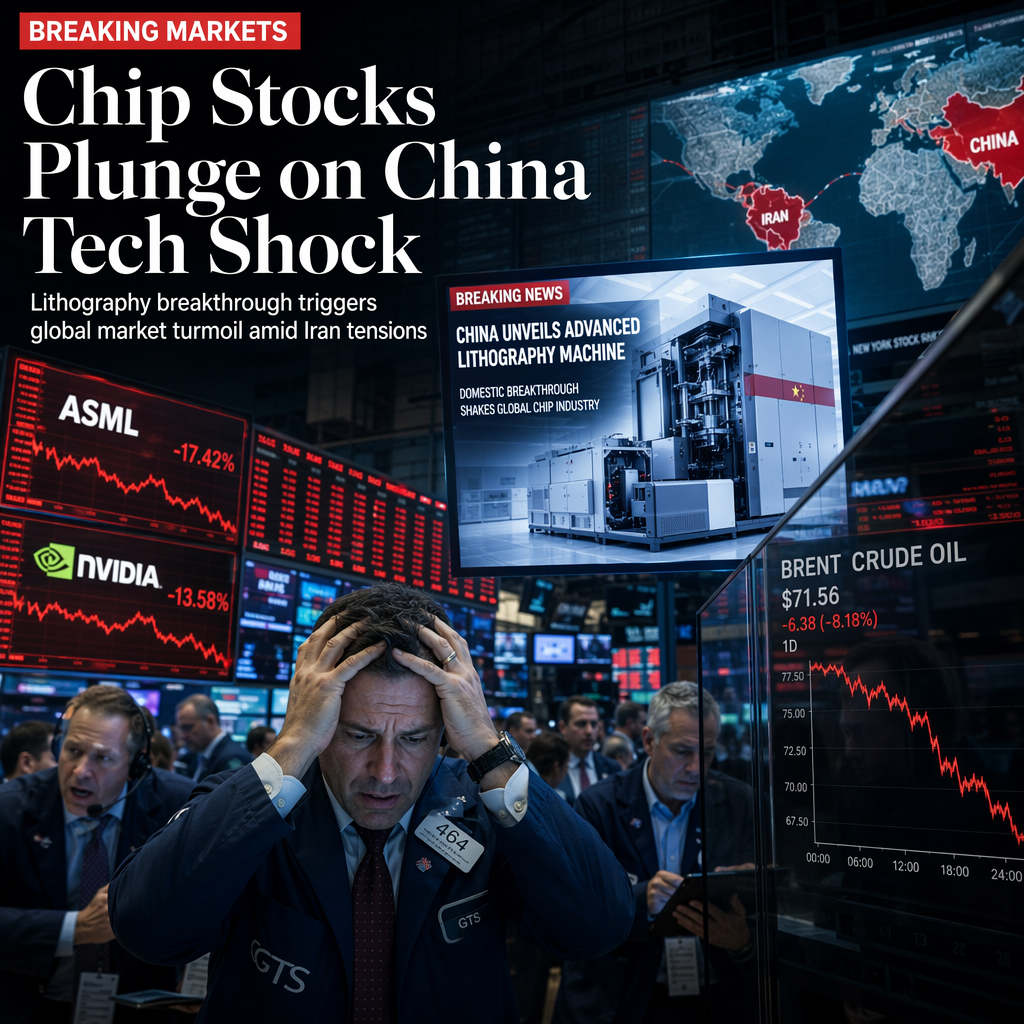
On Monday, July 27, 2026, global financial markets opened with optimism after President Trump decided to pause U.S. military strikes on Iran over the weekend, which led to a sharp drop in oil prices. Brent crude fell nearly 5%, dropping from approximately $98.75 to around $93.50 within minutes of the session's start, while WTI crude sank by roughly 7%, moving from the high $86s to the low $83s. This risk-on sentiment initially lifted Wall Street, with the Dow Jones Industrial Average rising as much as 1.3% and the Nasdaq Composite gaining over 1% in early trading [1][2].
However, the positive mood quickly reversed as chip stocks experienced a steep selloff. The catalyst was a report that a Shanghai-based, state-backed Chinese firm had begun mass-producing domestic DUV lithography machines, a technology previously dominated by ASML. This development rattled investors, as ASML fell more than 7%, dragging down Applied Materials, Lam Research, and KLA Corp. Nvidia dropped roughly 5%, AMD fell more than 8%, and Micron lost close to 6%. The Philadelphia Semiconductor Index was on pace for its third consecutive decline [2].
The selloff erased earlier gains, with the S&P 500 slipping into the red and the Nasdaq giving back its entire advance by midday. The report also highlighted that memory maker CXMT went public in Shanghai, briefly becoming China's most valuable listed company. The reversal in chip stocks occurred just two days ahead of the Federal Reserve's rate decision scheduled for Wednesday, July 29, with futures markets split between a hold and a possible hike [2].
Other key economic data released included U.S. Durable Goods Orders for June 2026, which rose 0.3% month-over-month (vs. 2.2% forecast), and Core Durable Goods Orders up 0.6% (vs. 1.0% forecast). The U.S. Dallas Fed Manufacturing Index for July 2026 came in at 1.3 (-1.0 forecast). In Europe, Germany's Ifo Business Climate for July was 86.6 (85.9 forecast), and the Euro area M3 Money Supply for June was 3.3% (3.2% forecast). The Bank of Canada Market Participants Survey showed expectations for the policy rate to remain at 2.25% through 2026, with the first move up only in 2027 [1].
Japanese Prime Minister Takaichi commented on the need to exit excessively tight fiscal policy and boost domestic investment, while stressing caution against reckless spending [1].
CONCLUSION
Monday's session saw a dramatic shift from early optimism to risk aversion, as a Chinese lithography breakthrough triggered a sharp selloff in semiconductor stocks and erased gains across major U.S. indices. Oil prices dropped significantly on easing Iran tensions, but the chip sector's losses dominated market sentiment. With the Federal Reserve's rate decision looming, investors remain cautious amid heightened geopolitical and technological uncertainty.