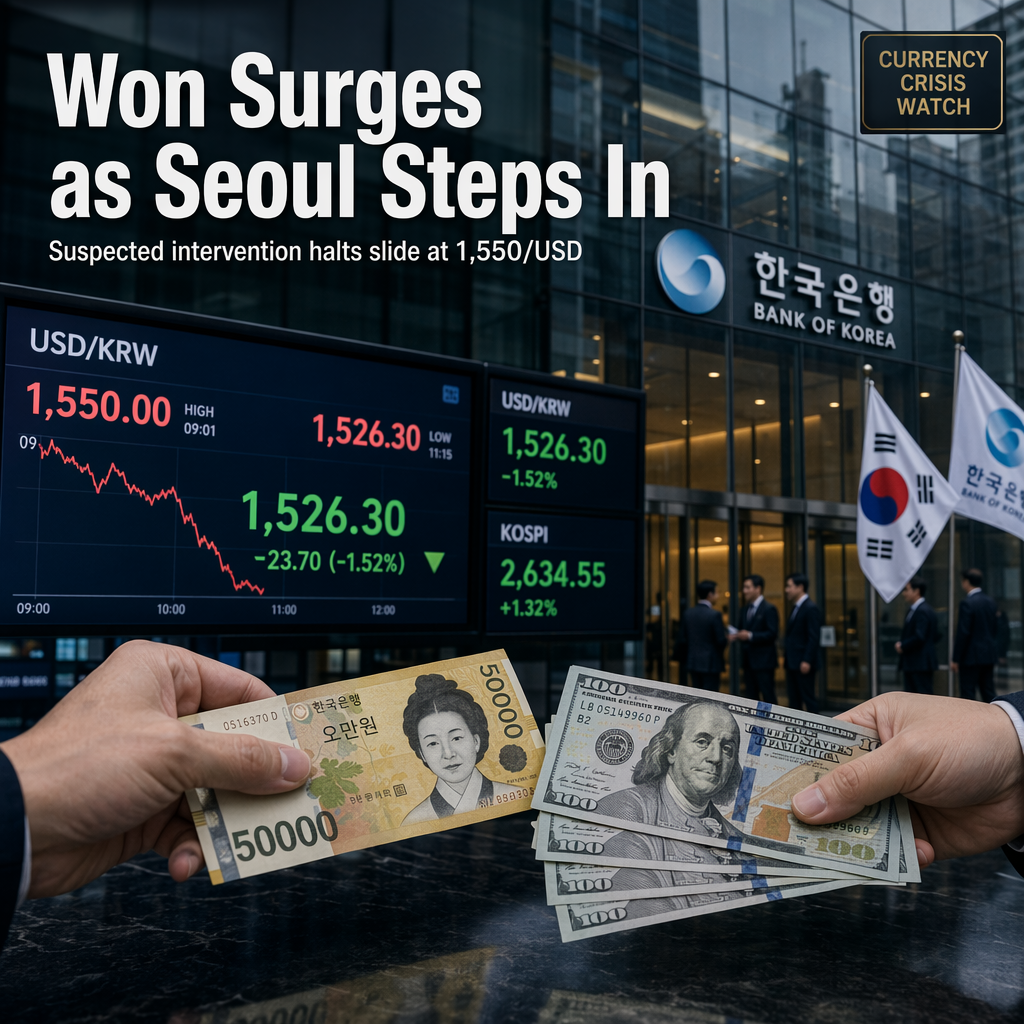
The South Korean Won (KRW) experienced a significant rebound on Friday after briefly touching the 1,550 level against the US Dollar (USD), which triggered speculation of direct intervention by the South Korean Ministry of Finance [1]. This move followed a week of steady KRW depreciation, driven by substantial capital outflows and persistent USD strength [1]. Comments earlier in the week from South Korea's Finance Minister Koo Yun-cheol, who stated that the mid-1,500s USD/KRW level is excessive given the country's fundamentals, have fueled rumors that authorities may have set 1,550 as a threshold for intervention [1]. A Reuters report cited by FXStreet supports this view, quoting a local trader who observed significant USD selling for intervention and suggested that 'it looked like authorities drew a line again at 1,550' [1].
The pressure on the KRW has been exacerbated by record net outflows from South Korean equities. Foreign investors sold 4.6 trillion Won worth of KOSPI shares earlier in the week, contributing to a record net outflow of 47 trillion Won (USD 30.6 billion) from South Korean stocks in May, according to the Korea Financial Supervisory Service [1]. These outflows were primarily attributed to rebalancing by American and European investors [1].
Currency analysts at Commerzbank highlighted that the KRW is currently the weakest performer among Asian currencies, a trend that is contributing to rising inflation and increasing pressure on the Bank of Korea (BoK) to raise interest rates [1]. BoK Governor Shiun Hyun-song stated earlier in June that the central bank must hike rates 'before it is too late' due to mounting risks in the financial and housing markets [1]. The next BoK policy meeting is scheduled for July 16, where a rate hike is anticipated [1].
CONCLUSION
The South Korean Won's sharp rebound at the 1,550/USD level has intensified speculation of government intervention, amid record capital outflows and mounting inflationary pressures. With the KRW underperforming regional peers and the Bank of Korea signaling a likely rate hike, market participants are closely watching for further policy actions to stabilize the currency and financial markets.