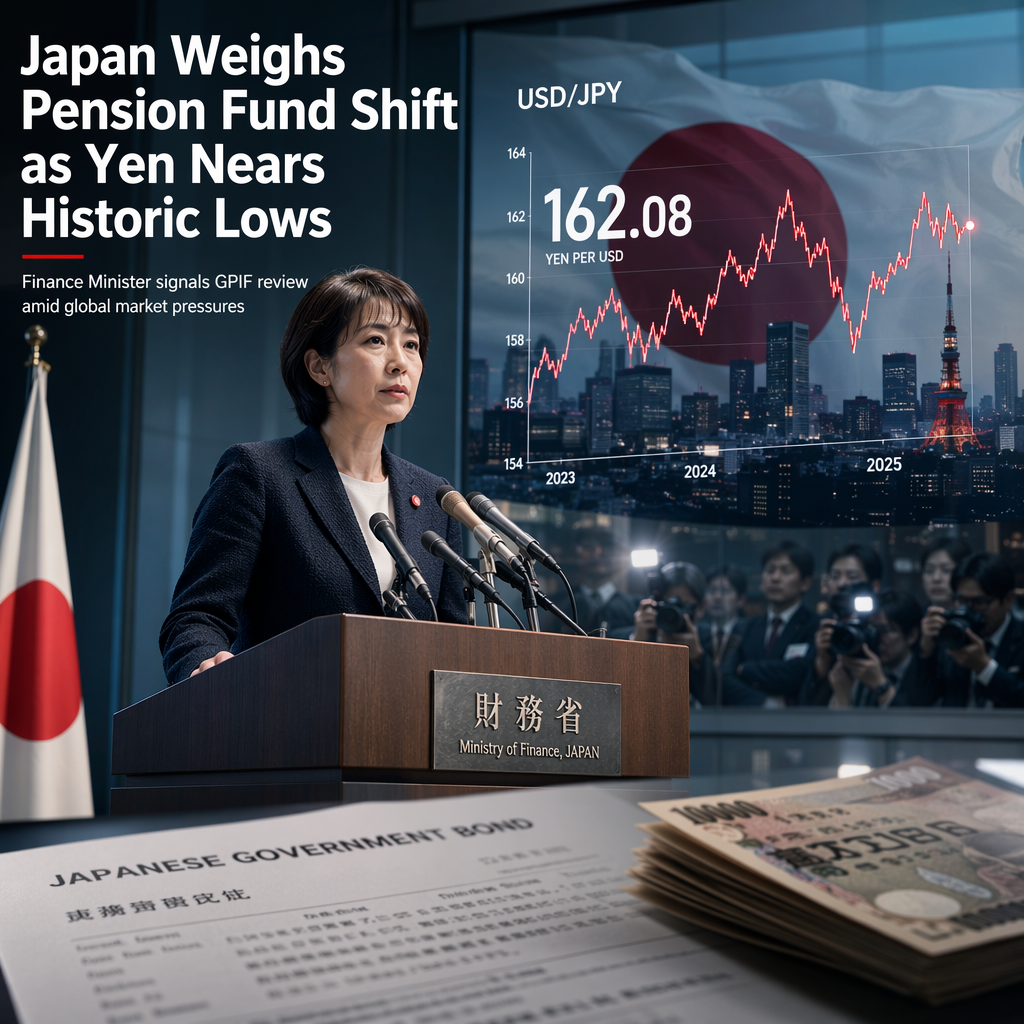
Japan's Finance Minister Satsuki Katayama stated that the government may consider reviewing the asset allocation of the Government Pension Investment Fund (GPIF) if there is a sharp shift in the investment environment, emphasizing that any changes would adhere to the rules set for the GPIF [1][2]. Katayama did not comment on whether a potential shift in GPIF's asset allocation could reduce foreign investments, but noted that Japan's asset appeal is expected to rise as the government advances its growth strategy and aims to swiftly finalize details to boost the appeal of Japanese government bonds [2]. He also confirmed that there is no change in the Japan-U.S. joint statement regarding the GPIF [2].
The USD/JPY currency pair is consolidating just below the mid-162.00s during the Asian session, remaining close to a four-decade high reached earlier this month [1]. At the time of reporting, USD/JPY was down 0.03% on the day at 162.40 [2]. Market participants are closely watching for potential intervention by Japanese authorities, given the Yen's proximity to historic lows [1]. The US Dollar's recent rally has paused as traders await the latest US consumer inflation data and testimony from US Federal Reserve Chair Kevin Warsh [1].
Geopolitical tensions in the Middle East, including a US blockade of Iranian ports and military strikes, have contributed to economic concerns for Japan, which relies heavily on imported oil from the region [1]. This, combined with a fresh rise in crude oil prices, has reignited inflation fears and bolstered expectations that the US Federal Reserve may raise borrowing costs by the end of the year [1]. Despite the Bank of Japan's recent rate hike to 1%, the highest since 1995, the widening US-Japan rate gap continues to support the so-called Yen carry trade and keeps the USD/JPY pair near its multi-decade highs [1].
Analyst commentary in the sources highlights that the Japanese Yen's value is influenced by Bank of Japan policy, the differential between Japanese and US bond yields, and broader risk sentiment [1][2]. The gradual unwinding of the Bank of Japan's ultra-loose monetary policy has provided some support to the Yen, but the persistent policy divergence with the US Federal Reserve remains a key factor [2].
CONCLUSION
Japan's Finance Minister's comments on a possible GPIF portfolio review have added to market focus on Japanese policy responses as the Yen trades near historic lows. While the USD/JPY pair remains elevated, market participants are awaiting further signals from both Japanese authorities and upcoming US economic data. The situation underscores ongoing concerns about rate differentials, geopolitical risks, and Japan's economic strategy.