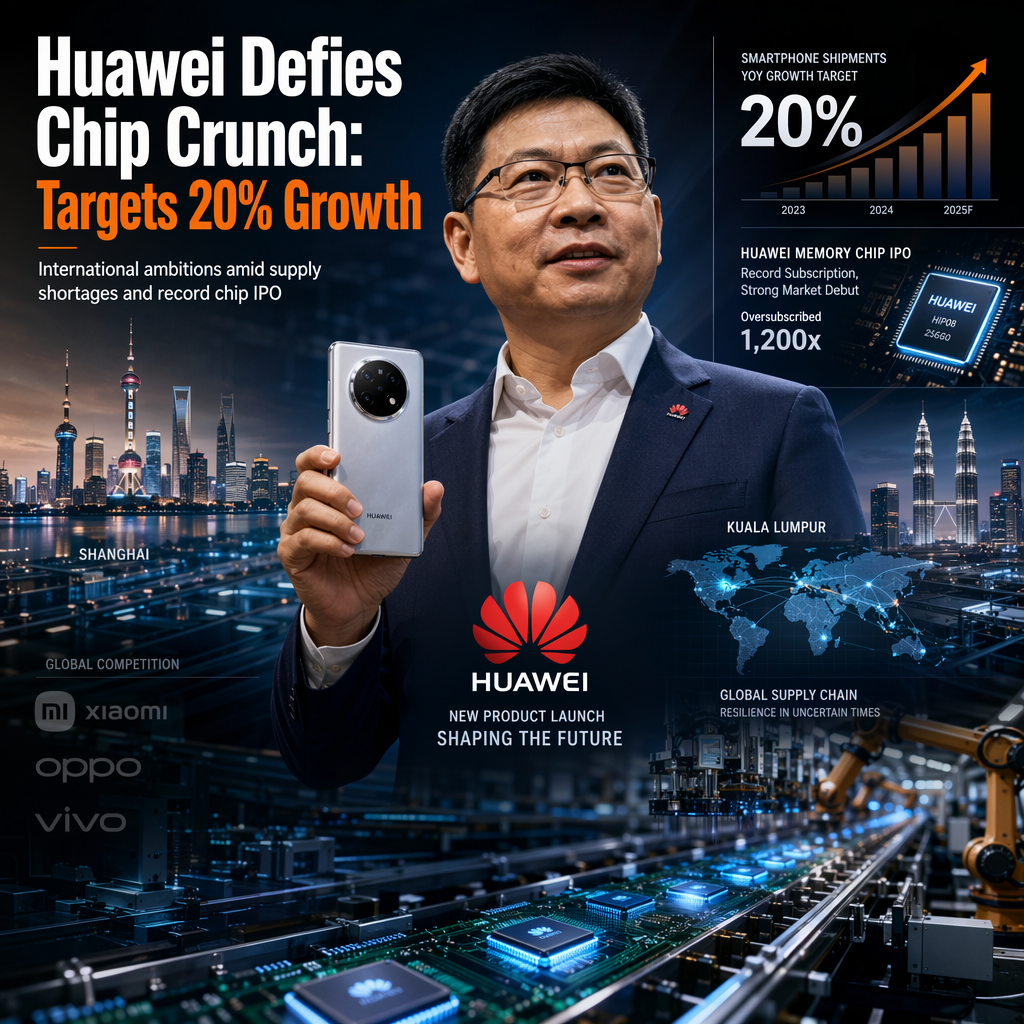
China's largest memory chipmaker, ChangXin Memory Technologies (CXMT), announced plans to raise over $8.54 billion in what would be the country's largest initial public offering by a chip company, according to a stock filing released 20 minutes before 9 p.m. on an unspecified date [1]. This move comes at a time when the global supply of memory chips remains tight due to surging demand for artificial intelligence infrastructure, with industry sources noting that companies with access to memory chips are positioned as market winners [1].
In the midst of this supply crunch, Huawei stands out as the only major Chinese smartphone manufacturer aiming to increase shipments in 2026. The company has raised its annual shipment target by 20% from the previous year to approximately 60 million smartphones [1]. This contrasts sharply with domestic competitors such as Xiaomi, Oppo, and Vivo, all of which have reduced their shipment forecasts multiple times due to difficulties in securing memory chips and rising component costs [1].
Huawei's strategy includes expanding its market share both domestically and internationally. On Tuesday, the company held its third international launch event in Kuala Lumpur, unveiling new smartphones, wearables, and a tablet as part of efforts to regain its international presence [1]. The company's technological strengths in networking, AI, and consumer tech have provided it with an advantage in sourcing components from domestic suppliers, supporting its ambitious shipment goals despite the ongoing supply constraints [1].
Additionally, there are signs of easing in some supply chain bottlenecks. An executive from a leading chip substrate supplier reported improved availability of high-end glass cloth, attributed to better production performance from a new Taiwanese supplier. However, the executive emphasized that Japanese company Nittobo still maintains unmatched capacity and quality in this area [1]. The increased output has allowed for more chip substrates, potentially leading to greater chip production and higher revenues [1].
CONCLUSION
Huawei's decision to raise its smartphone shipment target by 20% to 60 million units sets it apart from domestic rivals struggling with memory chip shortages and rising costs. The company's technological edge and improved access to domestic components position it to capitalize on ongoing market demand, while CXMT's record-setting IPO signals robust investor interest in the Chinese semiconductor sector.