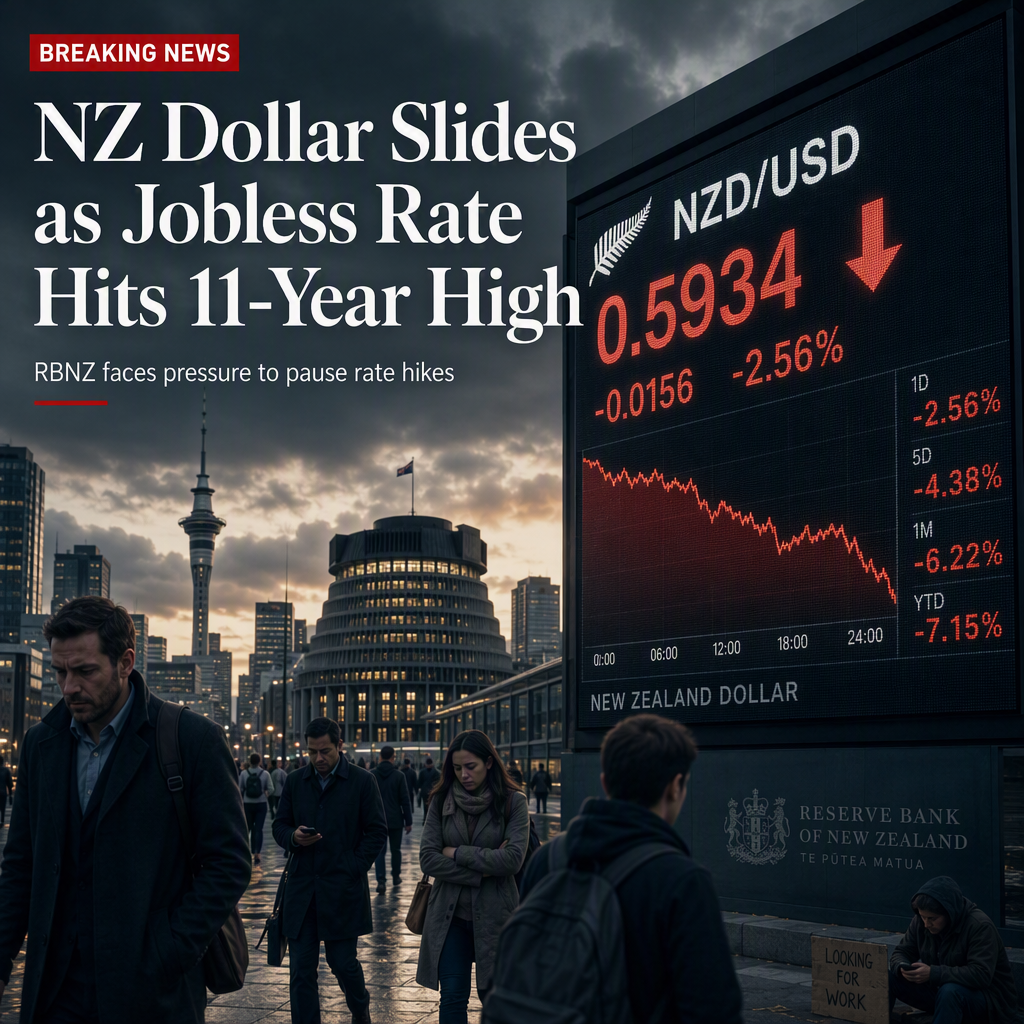
The New Zealand Dollar (NZD) weakened sharply against the US Dollar (USD), with the NZD/USD pair dropping to near 0.5870 during early European trading hours on Wednesday, following the release of New Zealand's latest labor market data [1]. According to Statistics New Zealand, the country's unemployment rate rose to 5.6% in the second quarter (Q2) of 2026, up from 5.3% in Q1, marking the highest level since 2015 and exceeding market expectations of 5.4% [1]. Despite the rise in unemployment, New Zealand's Employment Change showed a 0.5% increase in the June quarter, compared to 0.2% previously, while the participation rate climbed to 70.7% from 70.4% in Q1 [1].
The spike in the jobless rate has dampened expectations for aggressive monetary tightening by the Reserve Bank of New Zealand (RBNZ), undermining the Kiwi's strength [1]. ING strategists noted that internal dynamics at the RBNZ may favor a more modest tightening path, with the policy debate potentially settling around a smaller 50 basis point 'insurance' tightening cycle, possibly involving an earlier move in September followed by a pause, rather than a prolonged series of rate hikes [1].
Technical analysis indicates that the NZD/USD pair maintains a constructive outlook on the daily chart, holding above the Bollinger middle band and the 100-day simple moving average (SMA). The Relative Strength Index (RSI) is around 60, suggesting bullish momentum remains but is not overstretched. Key resistance is seen at the Bollinger upper band near 0.5910, while immediate support lies in the 0.5820-0.5825 area [1].
Broader market sentiment may be influenced by hopes of a breakthrough between the US and Iran regarding the reopening of the Strait of Hormuz, which could help limit NZD losses. US President Donald Trump stated he had very productive talks with Iran, and reports suggest the US, Iran, and Oman are nearing an interim deal, with a possible announcement expected Wednesday [1].
CONCLUSION
The unexpected rise in New Zealand's unemployment rate to an 11-year high has pressured the NZD and reduced the likelihood of aggressive RBNZ rate hikes. While technical indicators suggest some underlying support for the currency, the labor market data and central bank outlook are likely to weigh on the Kiwi in the near term.