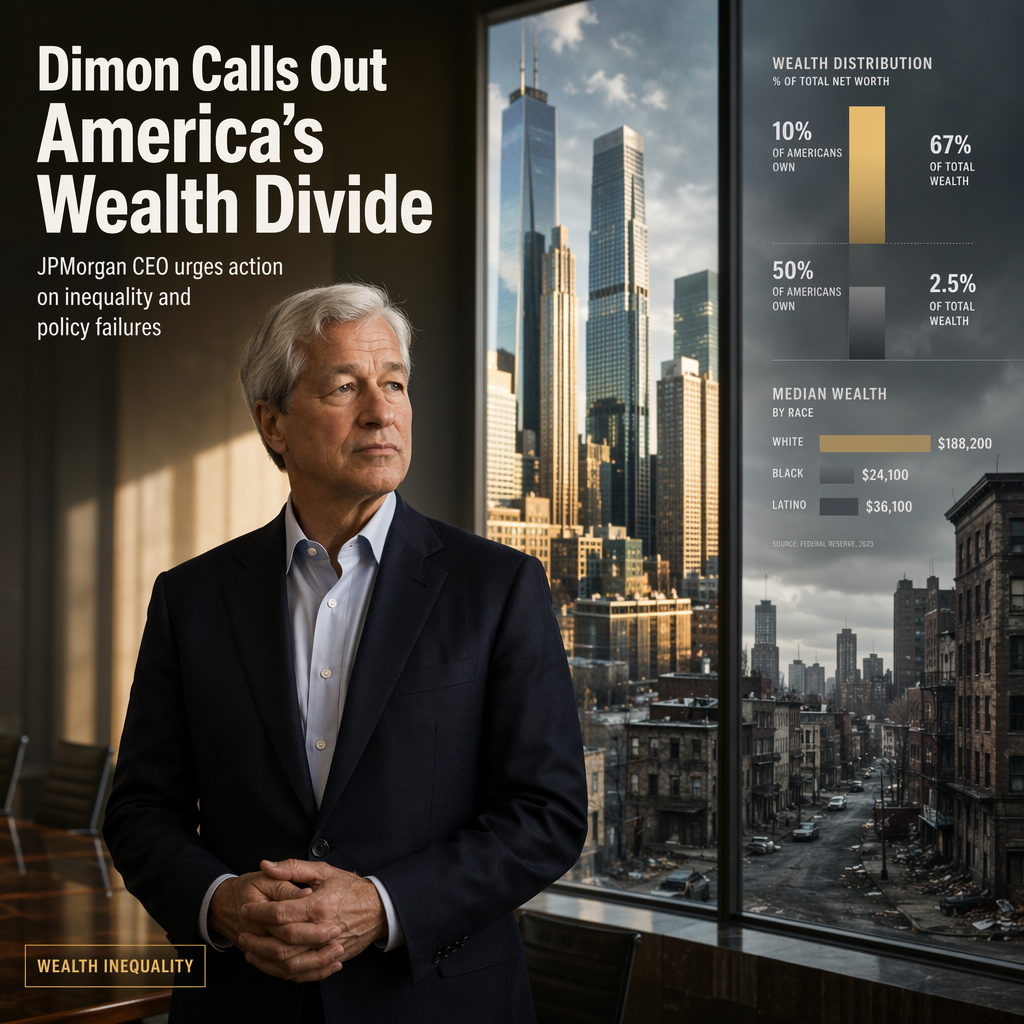
JPMorgan Chase Chairman and CEO Jamie Dimon publicly addressed the rising anti-rich sentiment in the United States, stating that he understands the frustration of working-class Americans who feel left behind by decades of ineffective public policies [1]. Dimon explained that lower-income families in rural and inner-city areas have been forced to contend with failing schools, rising crime, and fewer job opportunities, while wealthy elites remain largely insulated from these challenges [1].
Dimon cited data from the Federal Reserve's Distributional Financial Accounts to highlight the stark wealth disparity in the country: the bottom 50% of households collectively hold $4.27 trillion of the nation's approximately $174 trillion in household wealth, whereas the top 0.1% control about $25.07 trillion, and those in the 99th through 99.9th percentiles own just under $30 trillion [1]. He emphasized that both Democratic and Republican policies have contributed to these outcomes, stating, 'All of those policies did not work in the inner cities' [1].
Despite acknowledging that Americans, including those with lower incomes, have generally done better over the decades, Dimon stressed the need to address the 'fraying of the American Dream,' particularly for lower-paid individuals [1]. He described JPMorgan's 'Vital Institutions' initiative, which aims to support low-to-moderate-income communities by directing capital, banking, and philanthropic resources to organizations such as hospitals, universities, and local governments [1].
Dimon concluded that economic strength and equal opportunity are essential for the country, and called for collective action from all political sides to ensure that lower-income Americans are not left behind [1].
CONCLUSION
Jamie Dimon's remarks underscore the growing concern over wealth inequality and the need for policy reforms to support lower-income Americans. His comments, backed by concrete data, highlight JPMorgan's efforts to address these disparities through targeted initiatives. The market may interpret his statements as a call for broader systemic change and increased corporate responsibility.