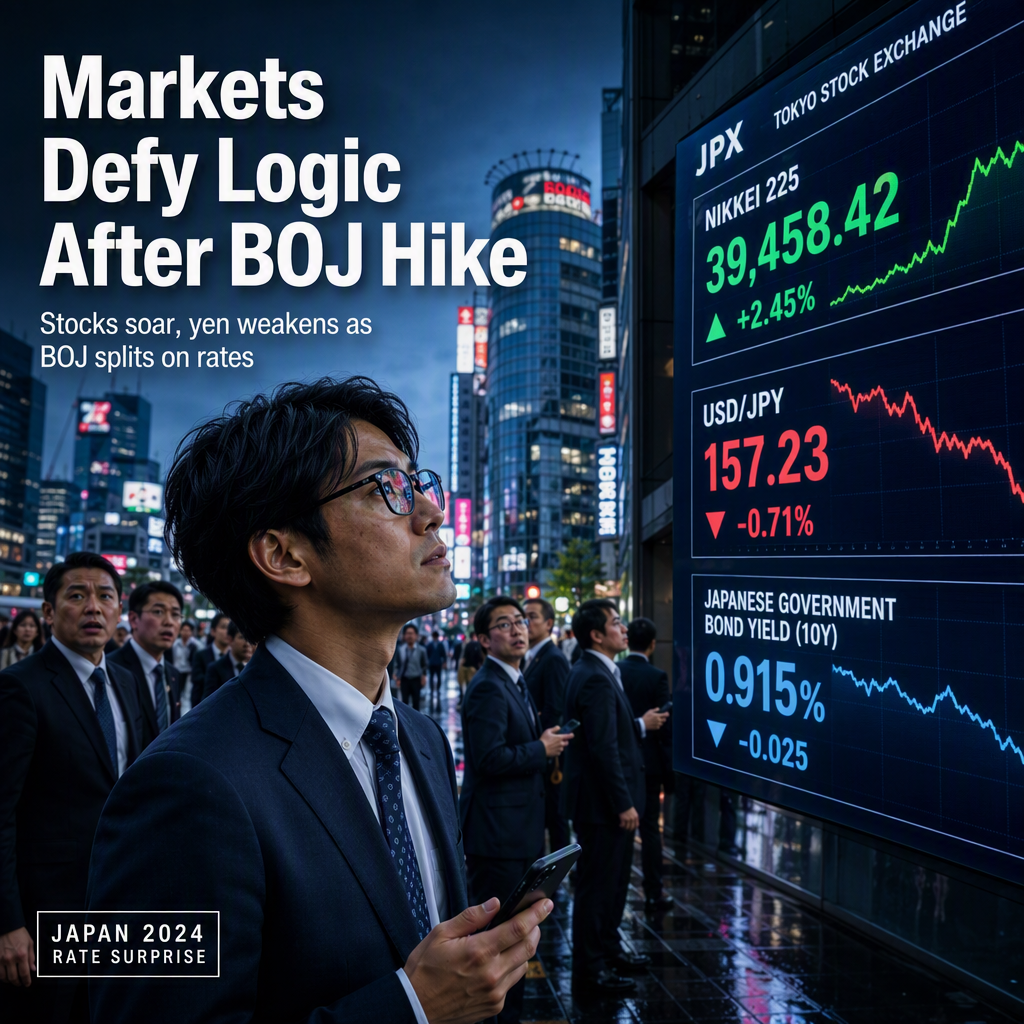
The Bank of Japan (BOJ) raised its policy rate by 25 basis points to 1.25%, marking its highest level since 1995 and coming just three months after the previous hike [1]. Despite this move, Japanese markets reacted in an unexpected manner: the yen weakened past 157 against the dollar, the yield on the 10-year Japanese Government Bond slipped, and the Nikkei 225 stock index gained 1.5% [1]. Typically, a rate hike would strengthen the currency, push up bond yields, and pressure equities, but the opposite occurred in this instance [1].
A key factor behind the market's counterintuitive response was the BOJ board's split decision, with two dissenting votes from Toichiro Asada and Ayano Sato, who advocated for keeping rates unchanged [1]. Asada cited core inflation below 2%—specifically, 1.7% in August, down from 1.8% in July—as a sign that the economic situation might not be robust enough for further tightening [1]. Sato also noted that economic and price developments had not substantially accelerated [1].
Analysts pointed out that the absence of an updated outlook report during this hike limited the BOJ's ability to reinforce a hawkish stance, contributing to the market's reaction [1]. Masahiko Loo of State Street Investment Management and Shigeto Nagai of Oxford Economics both highlighted that the tone of the BOJ's statement was less hawkish than markets had anticipated, with language similar to the previous quarterly outlook [1].
Looking ahead, experts believe another rate hike, possibly in December, is likely, with State Street's Loo expecting BOJ Governor Kazuo Ueda to keep all future meetings 'live' for potential action [1].
CONCLUSION
Japan's latest rate hike to 1.25% surprised markets, as the yen weakened, bond yields fell, and stocks rallied, contrary to typical expectations. The split BOJ decision and lack of a hawkish outlook contributed to this reaction. Analysts anticipate the possibility of another rate hike later in the year, keeping market participants alert for further developments.