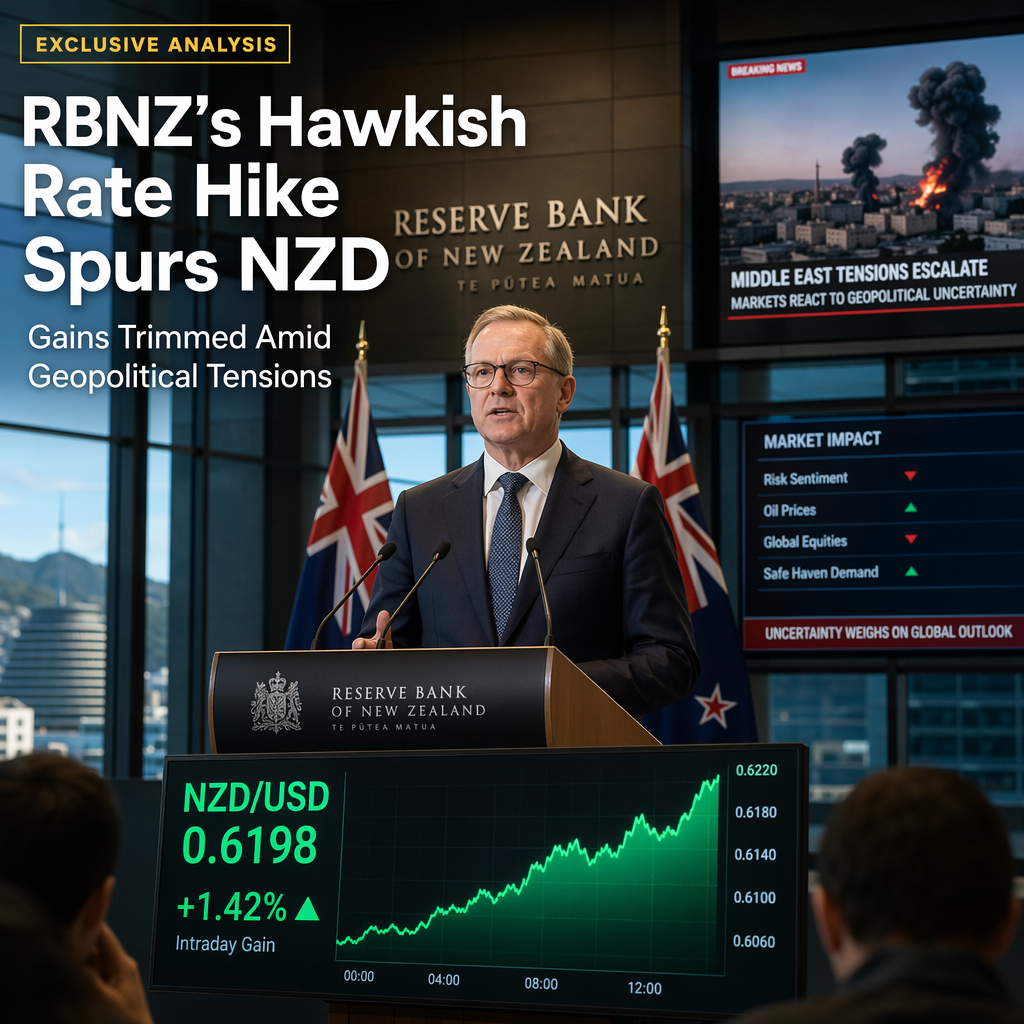
The Reserve Bank of New Zealand (RBNZ) raised its Official Cash Rate (OCR) by 25 basis points to 2.50%, marking the first rate hike in three years, according to Brown Brothers Harriman’s (BBH) Elias Haddad [1]. This move was largely anticipated by the market, with approximately 70% of the hike already priced in prior to the announcement [1]. The RBNZ signaled a continued hawkish stance, stating that 'further OCR increases appear likely at upcoming meetings,' and noted that the decision was reached by consensus, though the Committee’s vote split was not disclosed [1].
The RBNZ estimates the neutral OCR range to be between 2.2% and 4.1%, and the swaps curve suggests that markets are pricing in nearly 100 basis points of additional tightening over the next twelve months—almost double the RBNZ’s policy path projection from May [1]. The central bank’s room to normalize the OCR to more neutral levels is seen as supportive for the New Zealand Dollar (NZD), especially as inflation remains above target and economic activity is expected to strengthen [1].
Following the announcement, the NZD rallied broadly, reflecting the hawkish tone and expectations for further tightening. However, these gains were later pared back due to renewed tensions in the Middle East, which impacted market sentiment [1]. No specific analyst opinions or forward-looking statements beyond the RBNZ’s guidance were provided in the source.
CONCLUSION
The RBNZ’s hawkish rate hike and guidance for further tightening initially boosted the NZD, underlining market confidence in the central bank’s normalization path. However, external geopolitical risks tempered gains, highlighting ongoing market sensitivity to global developments.