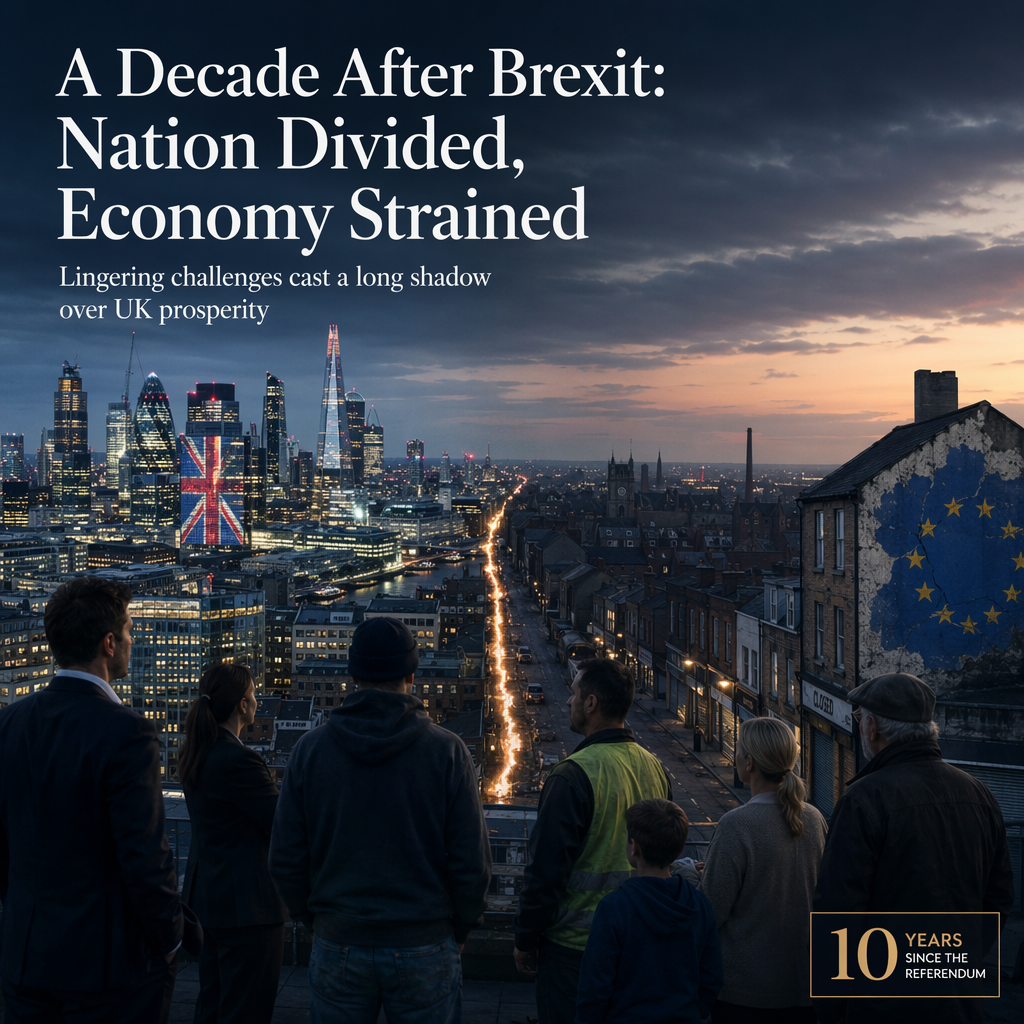
Ten years after the United Kingdom voted to leave the European Union, Brexit continues to divide the nation and cast a shadow over its economy [1]. The referendum, held on June 23, 2016, saw 52% of voters—over 17 million people—choose to leave the EU, resulting in the most significant upheaval in the UK’s economy and society since World War II [1]. The process of leaving took nearly five years to complete, and the effects are still being felt today [1].
Supporters of Brexit envisioned a revitalized British economy, free to focus on domestic priorities and global trade opportunities. However, the anticipated economic revival has not materialized, with the British economy remaining between 4% and 8% smaller than it would have been had the UK stayed in the EU, according to experts [1]. This shortfall translates to higher living standards and billions more in public services that could have been realized, including the National Health Service, which was promised an extra 350 million pounds ($468 million) a week by Brexit campaigners [1]. Jonathan Portes, professor at King’s College London, stated, “Brexit has made the U.K. economy smaller than it otherwise would have been,” describing the impact as a gradual and cumulative drag on trade, investment, and productivity rather than a sudden collapse [1].
Merchants have reported increased hurdles in trading with the EU, which remains the UK’s largest trading partner. While there are no tariffs on British goods entering the EU, businesses face numerous non-tariff barriers such as complex customs paperwork, border certifications, and visa restrictions [1]. Many of the trade deals promised by Brexit supporters, notably with the United States, have not come to fruition [1].
Brexiters maintain that the benefits of leaving the EU should not be judged in the short term, acknowledging that some economic disruption was expected in exchange for long-term gains [1]. However, the article notes that the COVID-19 pandemic and international conflicts have also contributed to the UK’s economic challenges, further complicating the assessment of Brexit’s true impact [1].
CONCLUSION
A decade after the Brexit referendum, the UK economy remains smaller than it would have been had it stayed in the EU, with ongoing trade barriers and unfulfilled promises of new trade deals. While supporters argue that long-term benefits may still emerge, current expert analysis points to a persistent drag on growth, investment, and productivity. The event continues to shape political identities and economic realities in Britain.