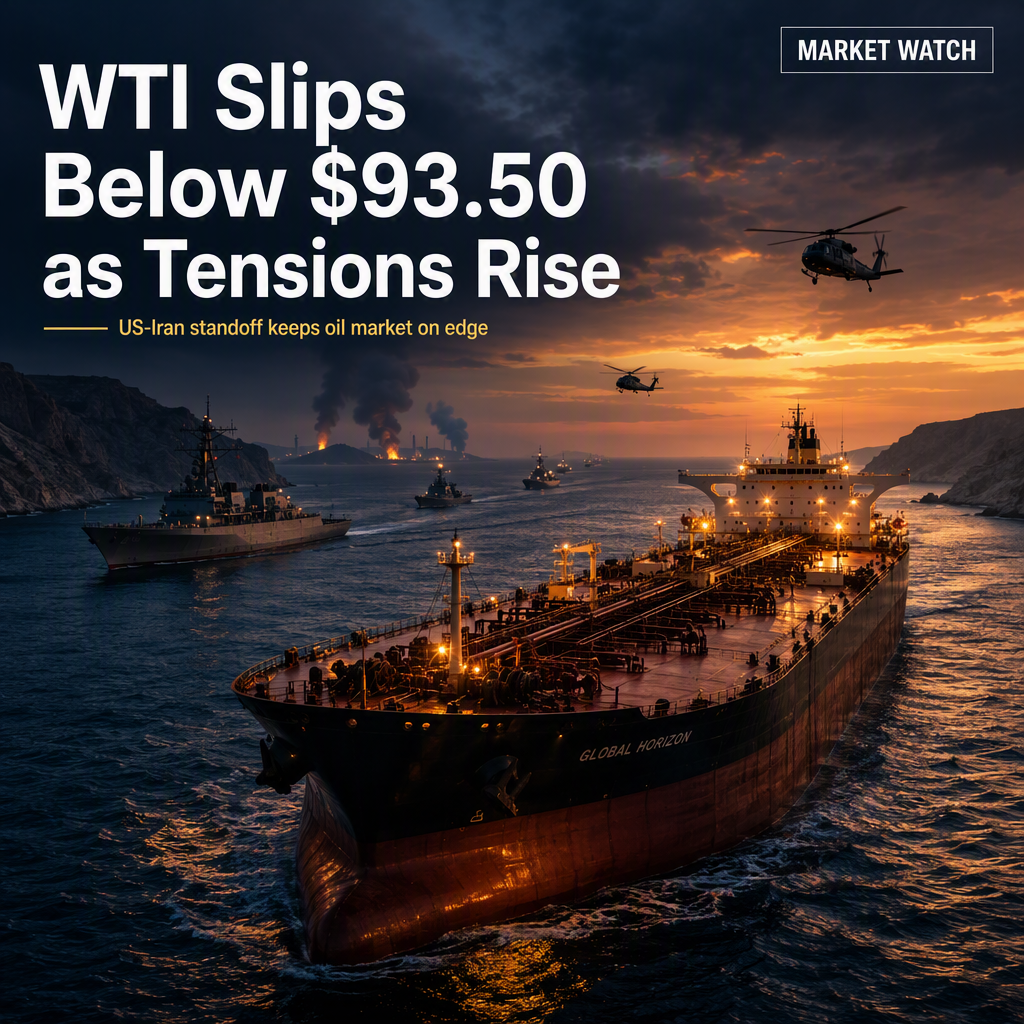
West Texas Intermediate (WTI), the US crude oil benchmark, traded around $93.20 during early European hours on Thursday, falling below $93.50 as traders engaged in profit-taking following a recent rally [1]. Despite this pullback, analysts suggest that downside risks may be limited due to escalating tensions between the US and Iran, as well as intensifying attacks on tankers in the Persian Gulf [1]. Reuters reported that Iran attacked 10 ships near the Strait of Hormuz after the US sank five Iranian oil tankers, marking the largest wave of attacks on shipping by both sides since the start of the six-month-old war [1].
A senior Iranian official stated that Iran is prepared for a more intense war and will escalate counterstrikes if the US continues its attacks on Iranian territory and infrastructure [1]. US Secretary of State Marco Rubio commented that Iran continues to target US naval ships, and warned that for every such attempt, Iran would lose tankers [1]. These developments have heightened concerns about potential disruptions to oil flows in the Middle East, which could support WTI prices in the near term [1]. ING commodity analysts noted that the risk of escalation could lead to meaningful disruptions in the Strait of Hormuz, potentially tightening the oil market further if flows are interrupted [1].
On the supply side, US crude oil inventories saw a modest weekly draw. The American Petroleum Institute (API) reported a decline of 300,000 barrels for the week ending September 4, compared to a 2.6 million barrel decrease in the previous week and a market consensus of a 1.3 million barrel draw [1].
Commodity strategists at TD Securities observed that crude prices continue to rise as geopolitical risks persist, with no end to the conflict in sight. They highlighted that the market remains on a tightening trajectory due to ongoing escalation and a preference for economic pressure over deal-making, reinforcing the tightness in oil fundamentals and sustaining upward pressure on prices [1]. Technical analysis indicates that WTI retains a bullish outlook above the 100-day simple moving average, with the Relative Strength Index (RSI) at 66.6, just below overbought territory [1].
CONCLUSION
WTI's recent dip below $93.50 is attributed to profit-taking, but ongoing US-Iran tensions and attacks on shipping are keeping the oil market tight and supporting prices. Analysts warn that further escalation could disrupt oil flows and tighten the market further, while technical indicators suggest the uptrend remains intact.